Flexible rollforming of carbon fiber profiles is emerging as a high-efficiency forming technology for automotive structural components. Traditional pultrusion produces straight, constant-cross-section profiles with excellent mechanical properties, but many automotive applications — roof
Introduction
Flexible rollforming of carbon fiber profiles is emerging as a high-efficiency forming technology for automotive structural components. Traditional pultrusion produces straight, constant-cross-section profiles with excellent mechanical properties, but many automotive applications — roof rails, window frames, door beltline reinforcements — require curved contours that follow the vehicle's body shape. Press forming can produce these shapes but suffers from slow cycle times and high tooling costs. Flexible rollforming bridges this gap by bending continuous carbon fiber profiles through adjustable roller stations that form complex contours at production speeds.
For automotive manufacturers and composite suppliers, the technology matters because it addresses the two barriers that have historically limited carbon fiber in mass-market vehicles: cycle time and cost. This article examines how flexible rollforming works, the process window for carbon fiber profiles, contour bending applications in roof rails and window frames, and a quantitative comparison with alternative forming methods.
How Flexible Rollforming Works
Flexible rollforming is an evolution of conventional rollforming in which the roll stations can be repositioned dynamically during the forming process. In conventional rollforming, all rolls sit in a fixed line, producing a straight profile. In flexible rollforming, each station is mounted on a movable carriage that can shift laterally, vertically, or rotationally as the profile passes through, so the profile is bent into a three-dimensional contour while its cross-section is progressively formed.
The process is particularly well suited to carbon fiber profiles made from pultruded or roll-formed thermoplastic composite blanks:
- Roll-formed thermoplastic blanks: Continuous fiber-reinforced thermoplastic (CFRTP) profiles, such as glass or carbon fiber reinforced polyamide or PEEK tape-laminated blanks, are heated above the matrix melting point and formed in the roll stations. The matrix solidifies as the profile cools, locking in the contour.
- Pultruded thermoset profiles: Straight pultruded sections can be pre-bent in a heated flexible rollforming line if the profile is produced from a partially cured (B-stage) prepreg, allowing the bend to be introduced before final cure.
- Hybrid approaches: Straight pultruded carbon fiber sections joined by rollformed thermoplastic corner elements combine the low cost of pultrusion with the forming flexibility of rollforming.
Typical line speeds for flexible rollforming of carbon fiber profiles range from 1-6 meters per minute for simple bends to 0.3-1 meter per minute for complex three-dimensional contours, depending on profile size, bend radius, and material system.
Process Parameters and the Forming Window
Successful contour bending of carbon fiber profiles depends on controlling several interacting process parameters. The table below summarizes the key parameters and their typical ranges for thermoplastic CFRTP profiles:
| Parameter | Typical Range | Effect on Quality |
|---|---|---|
| Forming temperature | 320-400 °C (PEEK), 250-290 °C (PA66) | Too low: fiber damage and delamination; too high: matrix degradation |
| Line speed | 0.3-6 m/min | Determines heating time, cooling rate, and residual stress |
| Minimum bend radius | 5-15 × profile thickness | Tighter radii increase fiber wrinkling on the inner surface |
| Roll pressure | 0.5-3 MPa contact pressure | Insufficient pressure causes fiber bridging at the bend apex |
| Cooling rate | 10-50 °C/min | Controls crystallization (semi-crystalline matrices) and warpage |
Two failure modes dominate contour bending of continuous fiber profiles. The first is fiber wrinkling on the inner (compression) side of the bend, which occurs when the fibers cannot accommodate the shorter path length; it reduces compressive strength and creates visible surface defects. The second is fiber straightening and delamination on the outer (tension) side, where the fibers must travel a longer path than the neutral axis. Designers mitigate both through bend radius limits, controlled tension, and multi-stage bending that spreads the deformation across several stations.
Springback Compensation
Springback is the elastic recovery of the profile after the forming rolls are removed, and it is the most important dimensional control issue in rollformed carbon fiber parts. When the profile exits the final roll station, the elastic energy stored in the fibers and matrix causes the part to partially return toward its original shape. Springback in carbon fiber profiles is typically 2-8% of the bend angle for thermoset materials and 1-4% for thermoplastics, depending on stiffness, matrix system, and cooling conditions.
Compensation strategies include:
- Over-bending: Programming the final roll stations to bend beyond the target angle by the measured springback amount, so the part relaxes into the correct geometry.
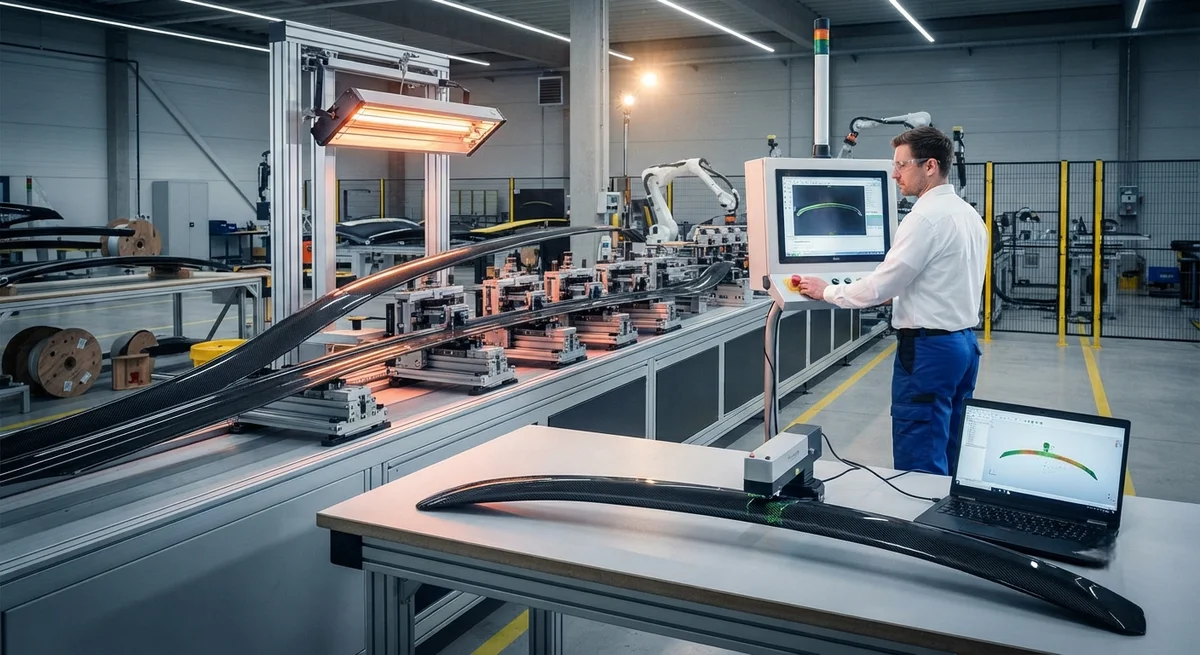
- In-line measurement: Using laser profilometers or optical sensors after the last station to measure the actual contour and feed corrections back to the servo-controlled roll carriages in real time.
- Process control: Maintaining consistent temperature, line speed, and cooling to keep springback variation within tolerance; thermoplastic parts show less variation when cooling is uniform.
For automotive roof rails and window frames, where dimensional tolerances of ±0.5 mm are common at mounting points, springback compensation combined with in-line measurement is essential for achieving assembly-ready parts without secondary straightening operations.
Applications: Roof Rails and Window Frames
Contour-bent carbon fiber profiles are finding growing application in automotive body structures where curved, high-strength sections replace stamped steel:
- Roof rails: The roof rail (also called the roof side rail) runs the length of the vehicle along the top edge of the body side, connecting the A, B, and C pillars. Its longitudinal curvature — often 30-80 mm of vertical drop over the rail length — makes it an ideal candidate for flexible rollforming. Carbon fiber roof rails reduce mass by 40-60% versus steel while contributing to roof crush strength.
- Window frames and beltline reinforcements: The side window opening frames and beltline reinforcements follow subtle curves both in plane and out of plane. Rollformed carbon fiber profiles provide the stiffness needed to prevent window glass flexure while eliminating the multi-piece stamped assemblies used in steel bodies.
- Structural ring members: The door opening ring — the closed loop formed by the roof rail, A-pillar, rocker, and C-pillar — can be produced as a continuous rollformed profile with integrated joints, improving both stiffness and crash performance.
These applications exploit the fundamental advantage of flexible rollforming: the ability to create continuous, fiber-aligned, curved profiles without the material waste of press forming or the cycle time penalty of matched-die molding. Fiber alignment along the part length preserves the unidirectional properties that make carbon fiber attractive in the first place.
Comparison with Alternative Forming Methods
Choosing between flexible rollforming and alternative processes depends on production volume, part complexity, and cost targets. The comparison below summarizes the trade-offs for carbon fiber profile forming:
| Criterion | Flexible Rollforming | Press Forming | Pultrusion (straight) |
|---|---|---|---|
| Cycle time per part | 0.5-3 min (continuous) | 3-10 min | 0.5-2 min |
| Contour capability | Two- and three-dimensional curves | Complex 3D shapes | Straight only |
| Tooling cost | Medium (adjustable stations) | High (matched dies) | Low |
| Material utilization | 85-95% | 60-75% | 90-95% |
| Fiber alignment | Excellent (continuous, aligned) | Good (can be cut to shape) | Excellent |
| Best fit | Medium-high volume, curved profiles | Low-medium volume, complex 3D | High volume, straight profiles |
For medium-to-high volume automotive programs (tens of thousands of parts per year), flexible rollforming offers the best combination of cycle time, material utilization, and tooling flexibility. Press forming remains competitive for low-volume complex geometries where the tooling investment can be justified, while pultrusion remains the low-cost option for the straight sections that flexible rollforming can then bend into contour.
Frequently Asked Questions
What is the difference between flexible rollforming and conventional rollforming?
In conventional rollforming, the roll stations are fixed in a straight line and the profile exits as a straight, constant-cross-section part. In flexible rollforming, each roll station is mounted on servo-controlled carriages that can move laterally, vertically, or rotationally while the profile passes through, allowing the machine to bend the profile into two- or three-dimensional contours during the same pass. This makes it possible to produce curved carbon fiber profiles such as roof rails and window frames at production speeds.
Can flexible rollforming be applied to thermoset carbon fiber profiles?
Yes, but with limitations. Fully cured pultruded thermoset profiles are difficult to bend because the thermoset matrix is rigid. The process works well with B-stage (partially cured) prepreg profiles that are bent while still formable and then fully cured, or with thermoplastic matrices that can be reheated and reformed. For fully cured thermoset sections, pre-bending during the pultrusion line or joining with rollformed thermoplastic corner elements are the practical alternatives.
How tight a bend radius can flexible rollforming achieve?
For carbon fiber profiles, the minimum bend radius is typically 5-15 times the profile thickness, depending on the material system. A 3 mm thick roof rail profile, for example, can typically be bent to radii of 15-45 mm without significant fiber wrinkling. Tighter radii are possible with specialized tooling but increase the risk of fiber damage on the inner surface and may require slower line speeds.
How does flexible rollforming compare with press forming for carbon fiber roof rails?
Flexible rollforming offers shorter cycle times (0.5-3 minutes versus 3-10 minutes), higher material utilization (85-95% versus 60-75%), and lower tooling cost because the adjustable roll stations serve multiple part geometries. Press forming retains advantages for highly complex three-dimensional shapes with undercuts or deep draws. For typical roof rail and window frame geometries, flexible rollforming is the more cost-effective process at medium-to-high volumes.
Conclusion
Flexible rollforming of carbon fiber profiles represents a significant step toward cost-effective, high-volume composite structures for automotive body applications. By combining the fiber alignment and mechanical performance of pultruded continuous fiber with the contour capability of rollforming, the technology enables curved structural components like roof rails and window frames to be produced at cycle times and costs that compete with steel stamping. Springback compensation and in-line measurement make the process dimensionally reliable, while the adjustable tooling spreads investment across multiple part programs.
YongXian supplies carbon fiber profiles, fabrics, and reinforcement materials for automotive structural applications. Explore our carbon fiber product range or contact our engineering team to discuss material systems and forming support for your rollforming program.
Part of topic
Related Articles
- Filament Wound Epoxy Tubing: Selection Guide for Industrial and Aerospace Applications
- Filament Wound Epoxy Tubes Advantages: Over Metal and Pultruded Alternatives
- Carbon Fiber Tube Strength: Analysis Methods and Design Allowables
- Filament Wound Epoxy Tubes: Mechanical Properties and Material Data Sheets
- Carbon Fiber Drone Blades and Propellers: Stiffness, Balance and Noise Reduction
- Fiberglass Filament Wound Tubes: Cost-Effective Alternative to Carbon Fiber
Interested in Our Products?
Contact our team for competitive pricing and technical specifications.
Get a QuoteRelated Products
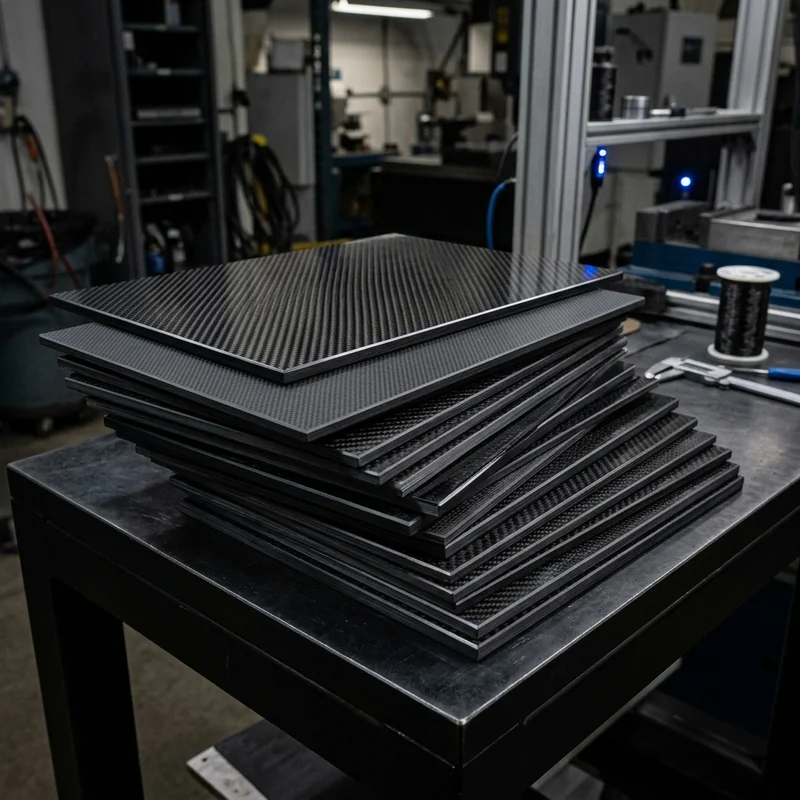
Carbon fiber standard plate-3k stripe
Lightweight, ultra-rigid standard sheets for drone fuselages, robot housings, facades and structural applications.

Carbon Fiber Plate — 3K Twill T700 3.0mm
Medium-thickness 3.0mm carbon fiber plate offering significantly higher load capacity while maintaining attractive 3K twill finish. Suitable for structural brackets, reinforcement plates, and load-bearing panels.

Carbon Fiber Plate — 3K Twill T700 1.5mm
Thin 1.5mm carbon fiber plate with 3K twill weave surface. Lightweight and stiff, commonly used for covers, panels, drone bodies, and applications requiring a premium aesthetic appearance.
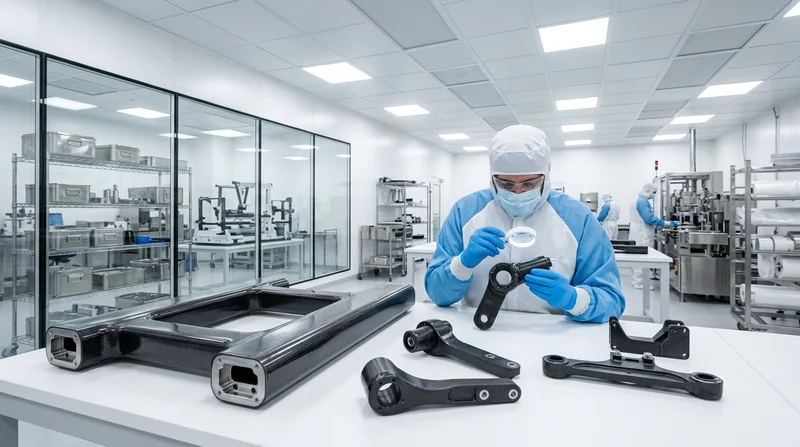
Custom Carbon Fiber Medical Device Components
Medical-grade carbon fiber components manufactured for imaging equipment, surgical instruments, and patient support systems. Carbon fiber's radiolucency (X-ray transparency) and high strength-to-weight ratio make it ideal for CT scanner beds, wheelchair frames, surgical robot arms, and MRI-compatible accessories. Biocompatible resin systems available.

Square Carbon Fiber Tube — 3K Twill T700
Square cross-section carbon fiber tube manufactured with 3K twill weave for torsional strength. Preferred for structural frames, trusses, and support columns where rectangular geometry offers design flexibility.