The Vietnam carbon fiber market is emerging as one of Southeast Asia's most strategically important composites growth stories in 2026. After years of positioning as a low-cost garment and footwear producer, Vietnam has transformed into a destination for high-value manufacturing relocati
Introduction
The Vietnam carbon fiber market is emerging as one of Southeast Asia's most strategically important composites growth stories in 2026. After years of positioning as a low-cost garment and footwear producer, Vietnam has transformed into a destination for high-value manufacturing relocation — a shift driven by tariff realignment, supply chain diversification away from China, and a government committed to export-led industrialization. For carbon fiber producers and component suppliers, the question is no longer whether Vietnam matters, but how fast its demand base will compound.
Vietnam's gross domestic product grew 6.8% in 2025 and is projected to maintain 6.5-7.0% growth through 2027, according to the World Bank. Manufacturing now accounts for roughly 25% of GDP, and foreign direct investment commitments reached $39 billion in 2025. This article examines the three demand pillars — electronics manufacturing, infrastructure buildout, and wind energy — and lays out a practical sourcing strategy for carbon fiber buyers.
The Electronics Manufacturing Shift: The Largest Near-Term Driver
Vietnam has become the preferred alternative production base for electronics supply chains seeking to reduce dependence on China. Samsung operates its largest smartphone production complex in the world in Thai Nguyen province, while LG, Foxconn, Goertek, and Luxshare have expanded factories across Bac Ninh, Bac Giang, and Ho Chi Minh City. The country now exports over $110 billion in electronics annually, roughly 32% of total export value.
This electronics boom creates direct carbon fiber demand in several categories:
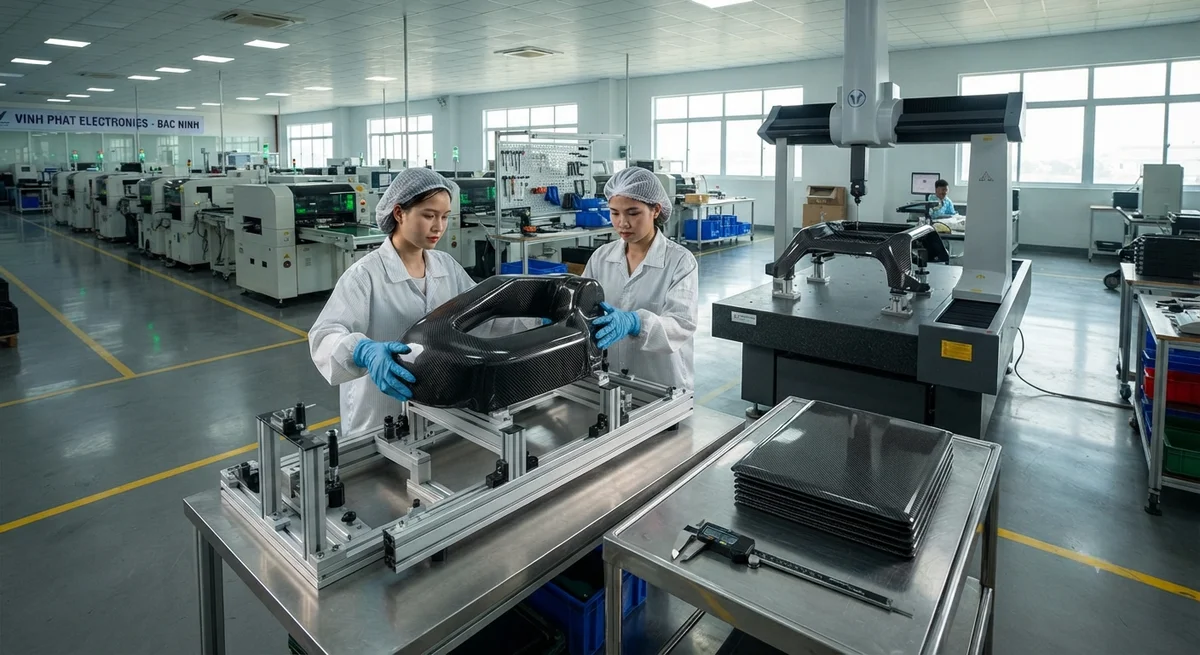
- Semiconductor and precision equipment frames: Carbon fiber structural components for wafer handling robots, cleanroom automation, and precision measurement fixtures — replacing aluminum for vibration damping and dimensional stability.
- Consumer electronics enclosures: Laptop lids, tablet frames, and premium audio equipment housings for brands with assembly operations in Vietnam, where thin-walled 0.5-0.8 mm carbon fiber laminates deliver stiffness at reduced weight.
- Automation and robotics: Pick-and-place gantry arms and end-effectors for electronics assembly lines, where carbon fiber's specific stiffness reduces cycle times and improves positioning accuracy.
- Test and inspection tooling: Stable composite fixtures for AOI (automated optical inspection) and X-ray inspection stations that must hold micron-level tolerances under thermal cycling.
The compound annual growth rate of Vietnam's electronics production has averaged 11.2% over the past five years — the fastest in Southeast Asia — and this trajectory is expected to continue as Apple diversifies iPad and MacBook assembly into the country.
Infrastructure Buildout: Metro, Highway, and Port Megaprojects
Vietnam's infrastructure spending is another compounding demand source. The government has committed to a $47 billion high-speed rail link between Hanoi and Ho Chi Minh City, scheduled to break ground in 2027, plus two metro lines in each of the major cities, a new Long Thanh International Airport, and a national highway upgrade program. Infrastructure construction typically consumes 8-12% of GDP annually in Vietnam — among the highest ratios in the region.
| Project Category | Scale (2026-2030) | Carbon Fiber Applications | Est. Composite Content (US$ M) |
|---|---|---|---|
| High-speed rail | 1,540 km route, 25 stations | Bogie frames, interior panels, driver cab shells | 210-340 |
| Urban metro | 6 lines (Hanoi & HCMC) | Third rail covers, cable trays, cladding | 35-60 |
| Long Thanh Airport | Phase 1, 25M passengers/yr | Facade panels, roof structures, baggage handling | 20-45 |
| Bridges & marine works | 40+ major bridges | CFRP rebar, stay cable ducts, formwork | 15-30 |
| Ports & logistics parks | 5 deep-water terminals | Crane components, equipment frames | 10-18 |
The infrastructure pipeline matters for carbon fiber suppliers for two reasons. First, it creates a local base of engineering contractors who will specify advanced materials for the first time. Second, the high-speed rail program — modeled on Japanese and Chinese rolling stock — will require composite bogie frames and interior components that no Vietnamese manufacturer currently produces, opening a direct import opportunity.
Wind Energy Potential: The Long-Dated Upside
Vietnam possesses one of the best offshore wind resource bases in Southeast Asia, with the World Bank estimating 475 GW of technical offshore wind potential. The government's Power Development Plan VIII targets 6 GW of offshore wind by 2030, ramping toward 70-90 GW by 2050. Onshore wind capacity already exceeds 7 GW and continues to grow in the Central Highlands.
Wind energy consumes significant carbon fiber in blades and, increasingly, in tower components. A single 15 MW offshore turbine blade set uses 20-35 tonnes of carbon fiber in the spar caps and shear webs. If Vietnam reaches even one-third of its 2030 offshore target, the annual carbon fiber requirement could reach 12,000-18,000 tonnes — comparable to the current annual consumption of the entire ASEAN region.
Supply Chain Structure and Import Dynamics
Vietnam currently has no domestic carbon fiber precursor or PAN fiber production capacity. All carbon fiber is imported — primarily from Taiwan (Formosa Plastics), South Korea (Hyosung), Japan (Toray, Teijin, Mitsubishi), and increasingly China. Import duties on carbon fiber typically range from 0-5% under ASEAN and CPTPP trade agreements, and Vietnam's participation in the CPTPP and RCEP provides favorable tariff treatment for member-country suppliers.
Local converters are concentrated in three clusters: Ho Chi Minh City and the southern industrial belt (electronics and consumer goods), the northern Red River Delta (Samsung ecosystem, automotive assembly), and Da Nang (emerging aerospace and marine activity). Because the conversion base is fragmented and specialized laminating capacity is limited, most B2B buyers source finished carbon fiber components directly from overseas manufacturers.
Frequently Asked Questions
What are the key differences between importing carbon fiber into Vietnam versus China?
Vietnam offers several structural advantages for importers. Tariffs are lower — most carbon fiber raw materials enter at 0-5% under CPTPP and ASEAN preferential schemes, versus 5-8% typical rates in China for non-domestic sources. Documentation requirements are simpler, with no dual-use export control regime comparable to China's licensing framework. Logistically, Vietnam's northern ports (Hai Phong) serve the electronics cluster within 24 hours, while the southern ports (Cat Lai, Cai Mep) handle consumer goods and marine applications. The main trade-off is scale: Vietnam's fragmented converter base means buyers with high-volume requirements often need to import finished components rather than raw material for local conversion.
Which carbon fiber applications will grow fastest in Vietnam over the next three years?
Three segments will grow fastest: electronics automation components (driven by the Samsung and Apple supply chain ecosystems), infrastructure-adjacent industrial products such as CFRP rebar and cable ducts (from the high-speed rail and metro pipeline), and offshore wind blade materials (from Power Development Plan VIII). Electronics demand is the most immediate — growing at 12-15% annually — while wind represents the largest absolute upside with a 2028-2030 inflection point.
Does Vietnam have enough local technical capability to support carbon fiber component manufacturing?
Partially. Vietnam has strong basic engineering talent and a rapidly growing precision manufacturing base, but specialized composites expertise remains thin. There are no significant domestic autoclave or AFP facilities as of 2026, and only a handful of companies perform resin transfer molding or prepreg layup at commercial scale. Most successful B2B strategies involve importing finished carbon fiber components, then performing secondary machining, assembly, and finishing locally. Several Korean and Taiwanese suppliers are establishing Vietnamese coating and assembly operations to serve the Samsung ecosystem.
Conclusion
Vietnam's carbon fiber market in 2026 sits at an inflection point. The electronics manufacturing shift provides immediate, compounding demand; the infrastructure megaprojects — especially the $47 billion high-speed rail program — build a domestic specification base for advanced composites; and offshore wind offers the largest long-term upside in the region. With no domestic carbon fiber production, every kilogram consumed in Vietnam is imported, making it a highly accessible market for overseas suppliers with competitive quality and logistics.
For buyers evaluating Vietnamese sourcing or suppliers planning to serve Vietnam, the practical path is to combine imported carbon fiber materials with local secondary processing. Browse our carbon fiber product range to identify components suited to Vietnam's electronics and infrastructure demand, or contact our engineering team for a market entry assessment with pricing and lead-time projections for the Vietnamese market.
Part of topic
Related Articles
- Carbon Fiber Sheet for Sale: In-Stock Inventory and Custom Order Lead Times
- Carbon Fiber Sheet Supplier: Direct Factory Pricing and Custom Cut-to-Size Services
- Carbon Fiber Sheet Roll: Continuous Roll Supply for High-Volume Production
- Carbon Fiber Parts Houston: Texas Manufacturing Hub and Energy Sector Demand
- Carbon Fibre for Sale: Reading Listings, Grades and Lead Times
- Carbon Fiber Near Me: Why Local Sourcing Beats Cross-Border for Prototyping
Interested in Our Products?
Contact our team for competitive pricing and technical specifications.
Get a QuoteRelated Products
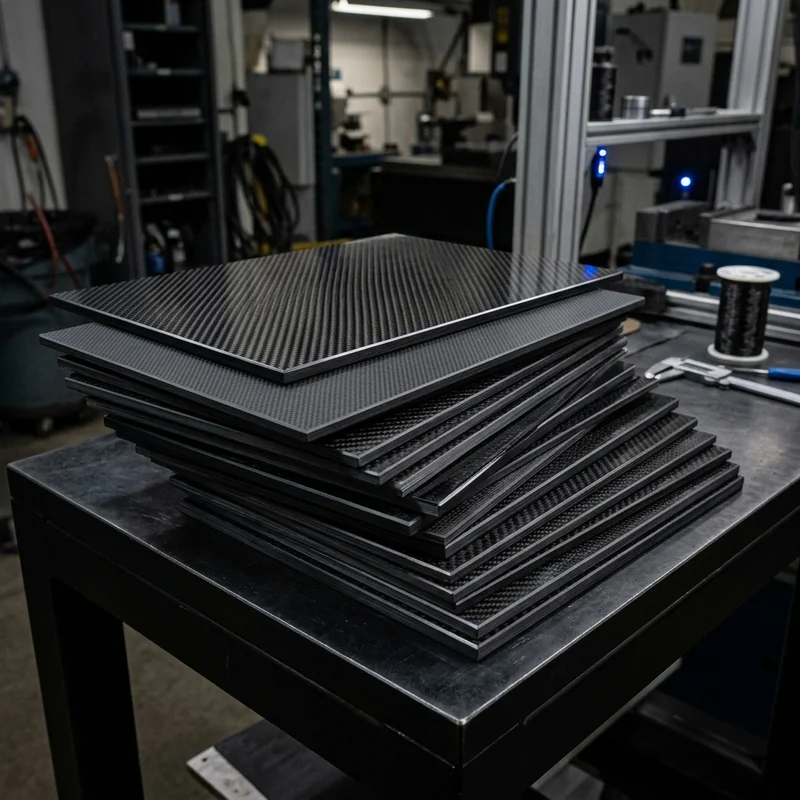
Carbon fiber standard plate-3k stripe
Lightweight, ultra-rigid standard sheets for drone fuselages, robot housings, facades and structural applications.

Carbon Fiber Plate — 3K Twill T700 3.0mm
Medium-thickness 3.0mm carbon fiber plate offering significantly higher load capacity while maintaining attractive 3K twill finish. Suitable for structural brackets, reinforcement plates, and load-bearing panels.

Carbon Fiber Plate — 3K Twill T700 1.5mm
Thin 1.5mm carbon fiber plate with 3K twill weave surface. Lightweight and stiff, commonly used for covers, panels, drone bodies, and applications requiring a premium aesthetic appearance.
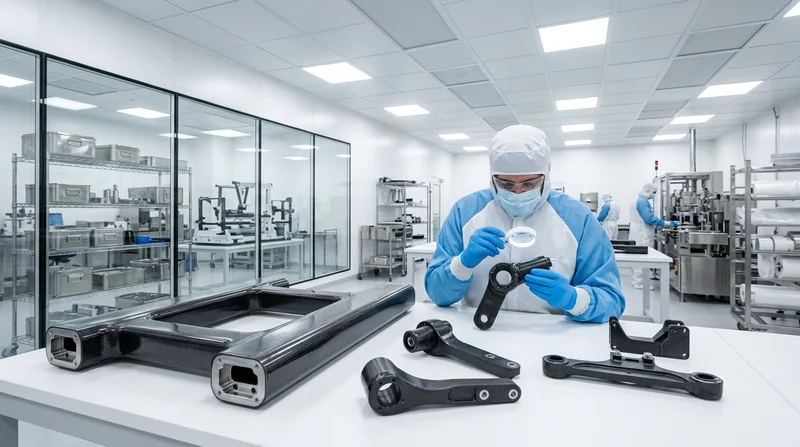
Custom Carbon Fiber Medical Device Components
Medical-grade carbon fiber components manufactured for imaging equipment, surgical instruments, and patient support systems. Carbon fiber's radiolucency (X-ray transparency) and high strength-to-weight ratio make it ideal for CT scanner beds, wheelchair frames, surgical robot arms, and MRI-compatible accessories. Biocompatible resin systems available.

Square Carbon Fiber Tube — 3K Twill T700
Square cross-section carbon fiber tube manufactured with 3K twill weave for torsional strength. Preferred for structural frames, trusses, and support columns where rectangular geometry offers design flexibility.