Anyone learning how to make carbon fiber tube quickly finds that the phrase hides three different factories: a filament winding line that drags wet tows around a rotating mandrel, a roll wrapping bench that lays prepreg plies by hand, and a pultrusion die that cures a constant section in one pass. T
Introduction
Anyone learning how to make carbon fiber tube quickly finds that the phrase hides three different factories: a filament winding line that drags wet tows around a rotating mandrel, a roll wrapping bench that lays prepreg plies by hand, and a pultrusion die that cures a constant section in one pass. The finished tubes can look identical from the outside while behaving completely differently in torsion, bending and crushing, so the first manufacturing decision is not the fiber grade — it is the process family.
This guide works through the filament winding vs roll wrapping question in shop terms: what each process does step by step, where a filament wound pipe is the right answer, how carbon fiber tube custom work changes fixtures and tolerances, and why pultruded vs roll wrapped carbon fiber should be decided against the load case rather than the price list.
How to Make Carbon Fiber Tube Blanks: Three Process Families
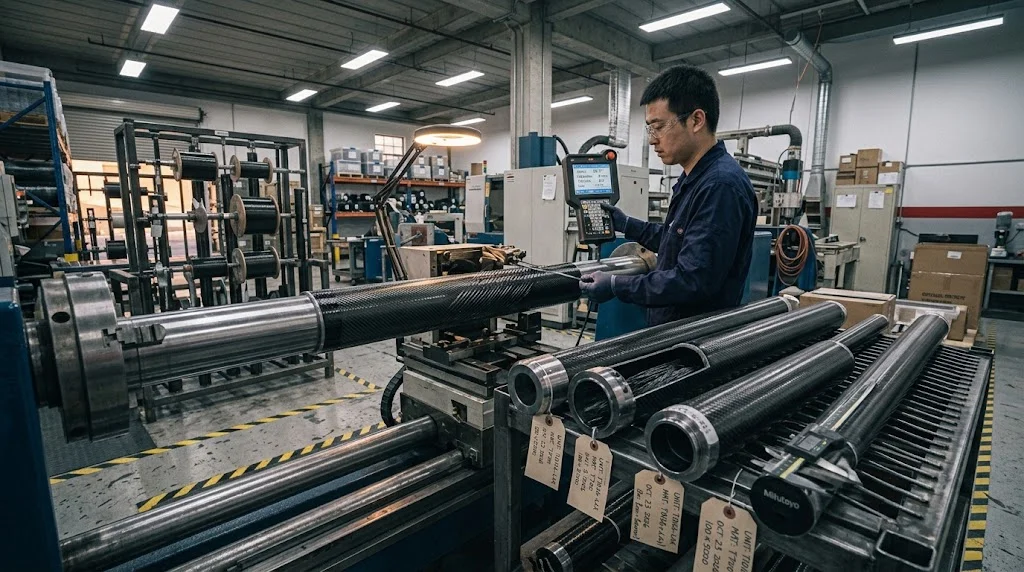
All three processes start from the same ingredients — carbon fiber, epoxy and a cylindrical tool — and separate at the moment the fiber meets the resin. Filament winding pulls dry or wetted tows over a rotating mandrel at a programmed helical angle; roll wrapping tapes prepreg onto a polished mandrel layer by layer; pultrusion pulls the fiber pack through a resin bath and a heated steel die that cures the section as it moves. Each choice locks the fiber architecture before the tube ever sees an autoclave.
| Attribute | Filament winding | Roll wrapping | Pultrusion |
|---|---|---|---|
| Fiber placement | Programmed helical / hoop angles | Hand-laid 0°, ±45°, 90° plies | Almost pure axial |
| Typical OD tolerance | ±0.1-0.3 mm | ±0.05-0.15 mm | ±0.1-0.2 mm |
| Best load case | Pressure, hoop and torsion | Bending plus torsion, precise OD | Straight axial stiffness |
| Tooling | Steel or aluminum mandrel per size | Polished mandrel per size | Die set per cross-section |
| Practical length | Up to 6 m and beyond | Typically 2-3 m max | Continuous, cut to order |
| Relative unit cost | 1.5-2x | 2-4x | 1x |
The table explains most procurement mistakes. A tube specified only by diameter and wall thickness can be filled by any column, and the buyer discovers the gap later: the winding angle that made the tube cheap also made it soft in torsion, or the hand-laid ply schedule that held tolerance also doubled the price.
Filament Winding vs Roll Wrapping: Where Each Wins
Filament winding wins when the load is internal pressure or torsion and the geometry is constant. Winding machines place fiber at exact angles — typically 54.7° for pure hoop stress, lower for axial duty — and the continuous tow enters the resin with little handling damage. That makes a filament wound pipe the natural answer for pressure vessels, drive shafts, tooling spars and large-diameter structural tubes, where the machine amortizes over long runs.
- Choose filament winding for: hoop-dominated loads, long runs of one size, tubes above roughly 50 mm OD, and applications where a slight surface cord texture is acceptable.
- Choose roll wrapping for: tight outside diameter tolerance, smooth cosmetic surfaces, mixed ply schedules with ±45° layers for torsion, and short to medium batches.
- Watch the interfaces: wound tube often needs a machined end or an overwrapped sleeve for fittings; roll-wrapped tube accepts bonding and press fits more readily because the OD is finished against the cured surface.
- Cost shape: winding tooling is a mandrel plus a winding program; roll wrapping labor scales with part length, so price rises faster with size than with batch count.
The comparison that matters is not which process is better, but which failure you would rather design around: wound tube tends to open on the bond line between plies under crushing, while roll-wrapped tube fails closer to the fiber limit because plies are consolidated under heat and pressure.
Carbon Fiber Tube Custom Work: Mandrels, Tolerances and Cure
Custom work is where the two processes diverge in fixtures. Every new outside diameter needs a new mandrel: filament winding can run on a cheaper aluminum or plated mandrel because winding tension is moderate, while roll wrapping wants a ground and polished steel tool because the laminate shrinks onto it during cure. Expect a one-time tooling charge per size, amortized over the batch.
- Tolerance to specify: OD ±0.1 mm achievable on roll-wrapped tube after finishing; ±0.2-0.3 mm typical for as-wound filament winding; wall thickness ±10% is a realistic target for both.
- Cure schedule: standard epoxy gels at 80-100 °C and post-cures at 120-150 °C; autoclave pressure of 0.4-0.6 MPa improves interlaminar strength but is not mandatory under heat-shrink film.
- Demolding: wound and roll-wrapped tubes shrink onto the mandrel — tapered mandrels, release film or chrome plating decide whether demolding damages the bore.
- Finishing: OD grinding and honing add about 0.05 mm repeatability; without grinding, surface release texture sets the final diameter.
Ask suppliers which steps are outsourced. Mandrel fabrication, grinding and non-destructive testing frequently move between in-house and subcontracted work, and each handoff is where tolerance stacks or schedule slips enter the order.
Frequently Asked Questions
Which process makes the strongest carbon fiber tube?
Strength depends on fiber architecture, not the label. Filament winding delivers the highest hoop and torsional strength at a given weight, roll wrapping gives the best balance of axial, ±45° and hoop properties in one laminate, and pultrusion maximizes axial tensile strength while staying weak in torsion. Match the process to the dominant load direction.
Can I make a carbon fiber tube at home with these methods?
Roll wrapping is the only one of the three that translates to a workshop: wet layup or prepreg over a PVC or aluminum mandrel, vacuum bagged and cured at 60-80 °C. Expect ±0.5 mm tolerance instead of ±0.1 mm, and never use the tube in pressure or people-bearing applications until it has been tested.
How long does custom tube tooling take?
Mandrels for standard sizes ship from stock; a new ground steel mandrel typically takes 1-2 weeks, plus about a week for a first-article run and inspection. Combined, most carbon fiber tube custom orders see first parts 3-4 weeks after drawing approval.
Conclusion
Making carbon fiber tube well comes down to matching the process to the load: filament winding for hoop and pressure duty, roll wrapping for tolerance and balanced plies, pultrusion for cheap straight sections. Specify tolerance, cure and finish alongside the fiber grade, and the tube you receive will behave the way the calculation assumed.
YongXian manufactures filament wound, roll-wrapped and pultruded carbon fiber tube to custom diameter, wall thickness and length. Browse our carbon fiber tube range or contact our engineering team with your drawing and target quantity.
Part of topic
Related Articles
- How to Make Carbon Fiber Plates at Small Batch Scale
- Carbon Fiber Plate Manufacturing Process: Ply Stack to Finished Panel
- How Carbon Fiber Is Made: From PAN Precursor to Composite
- How to Cut Carbon Fiber Plate: Tools, Feed Rates and Dust Safety
- How to Cut Carbon Fiber Sheets Without Delamination
- Making Carbon Fiber Parts: From Layup to Curing
Interested in Our Products?
Contact our team for competitive pricing and technical specifications.
Get a QuoteRelated Products

Round Carbon Fiber Tube — 3K Plain Weave T700
Standard round carbon fiber tube manufactured from Toray T700 grade fiber with 3K plain weave. Offers balanced strength and stiffness for general industrial applications including robotics, automation, sports equipment, and aerospace structures.

Carbon Fiber Pickleball Paddle
High-performance pickleball paddle with Toray T700 carbon fiber face and polypropylene honeycomb core. Delivers excellent power-to-weight ratio, spin generation, and vibration dampening for competitive play.

Square Carbon Fiber Tube — 3K Twill T700
Square cross-section carbon fiber tube manufactured with 3K twill weave for torsional strength. Preferred for structural frames, trusses, and support columns where rectangular geometry offers design flexibility.
Carbon Fiber Trekking Pole
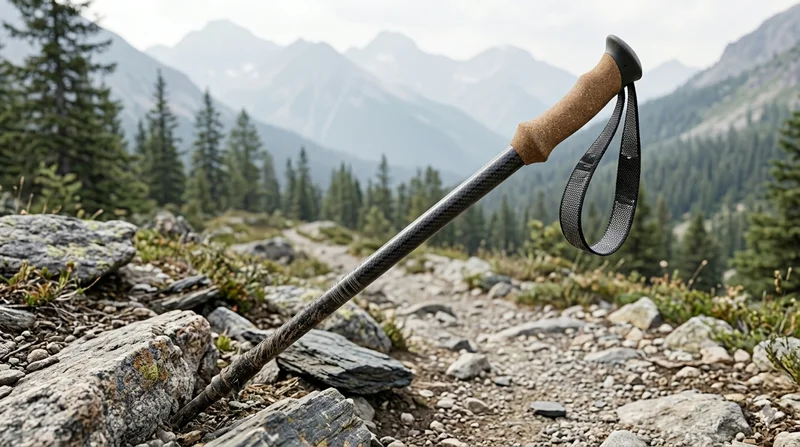
Lightweight carbon fiber trekking pole manufactured from high-grade carbon fiber tube. Weighs only 160g per pole while providing superior shock absorption and durability for hiking, trail running, and backpacking.

Round Carbon Fiber Tube — 3K Twill
Lightweight and ultra-stiff round tubes ideal for drone frames, robotics, and structural applications.