Carbon fiber plate running shoes are the clearest example of aerospace material crossing into consumer products at scale. A carbon fiber plate running shoe uses a thin, spring-like carbon fiber plate embedded in the midsole to return energy during the gait cycle, and the technology has spread from e
Introduction
Carbon fiber plate running shoes are the clearest example of aerospace material crossing into consumer products at scale. A carbon fiber plate running shoe uses a thin, spring-like carbon fiber plate embedded in the midsole to return energy during the gait cycle, and the technology has spread from elite marathons to everyday trainers in less than a decade. The plate is not a gimmick: measured energy return differences, race records, and the number of major brands now building shoes around a plate all confirm that the material genuinely changes running performance.
Behind every pair of carbon fiber plate running shoes is a manufacturing story that determines price, consistency, and durability. This article explains how a CFRP running plate is actually made — from the prepreg or molding process to trimming and bonding — and the material specifications that separate a factory-grade carbon fiber shoe insert from a decorative one. It is written for footwear brand sourcing teams, product developers, and technically curious runners who want to understand what they are buying.
Why a Carbon Fiber Plate Works in a Running Shoe
The plate works through a combination of stiffness and geometry. Embedded between the midsole foam layers, a curved carbon fiber plate acts as a lever: as the runner lands, the plate deflects, stores elastic energy, and releases it during toe-off. The effect is a measurable reduction in energy cost at race pace — studies and product testing commonly report 1-4% improvements in running economy, which translates to minutes over a marathon for elite runners.
The material choice is not arbitrary. Carbon fiber composite offers the highest stiffness-to-weight ratio available at reasonable cost, and it does so in a thin profile that fits inside a shoe without adding bulk. The plate is typically 1.0-1.6 mm thick, weighs 15-30 grams depending on shoe size and curvature, and is curved in a rocker geometry that works with the foot's natural rolling motion. The table below summarizes typical plate specifications:
| Parameter | Typical Range | Notes |
|---|---|---|
| Thickness | 1.0-1.6 mm | Thicker for stability models, thinner for racing |
| Weight | 15-30 g | Depends on size and plate geometry |
| Fiber grade | T700-class | Balanced strength and stiffness at reasonable cost |
| Fiber volume fraction | 55-65% | Drives stiffness and durability |
| Modulus (flexural) | 100-150 GPa | Higher modulus = stiffer plate |
| Curvature | Rocker geometry | Matches foot roll during gait |
Stiffness is tuned to the runner. A stiffer plate suits heavier runners and speed-focused models, while a softer, thinner plate works for daily trainers and lighter runners. This tuning is why plate specifications vary across a brand's lineup rather than being a single universal geometry.
Manufacturing Process for Carbon Fiber Plate Running Shoes
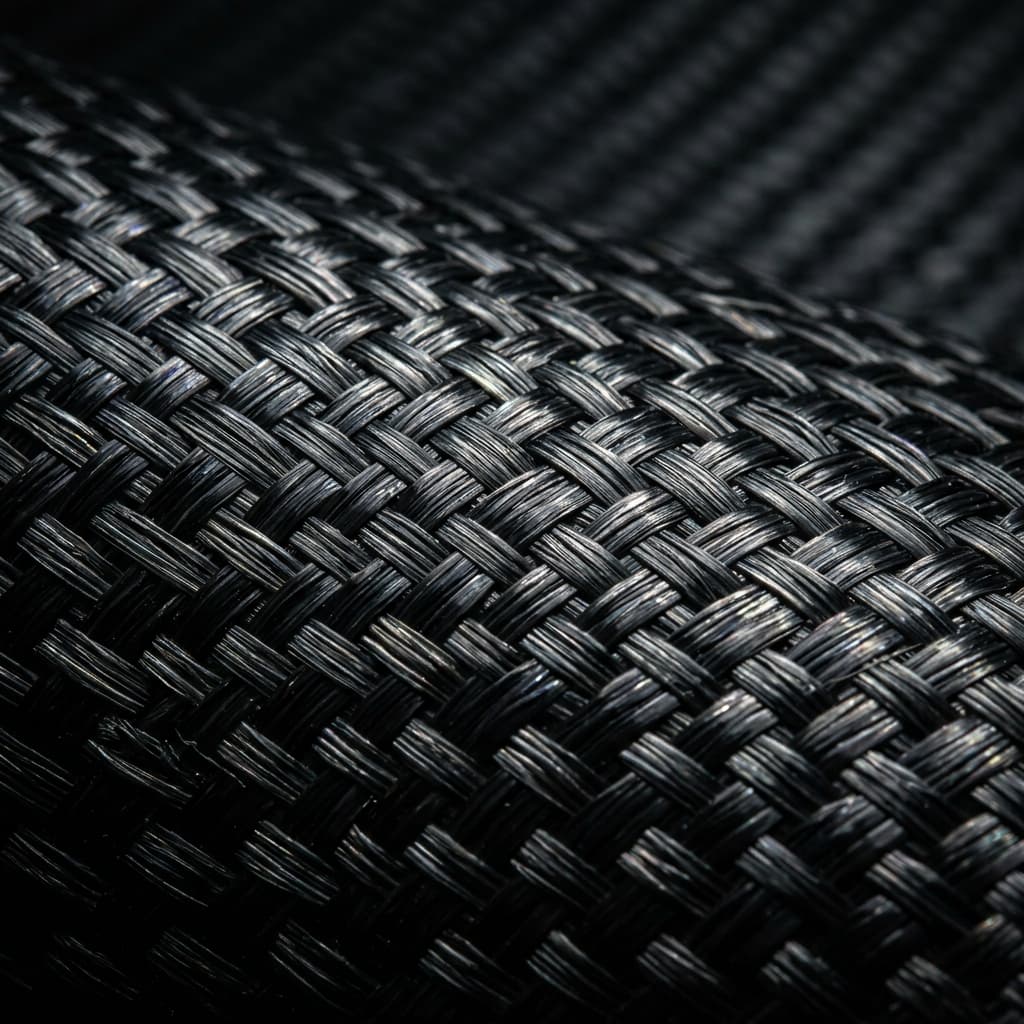
The production of a carbon fiber plate running shoe starts with material, not geometry. Most plates are made from unidirectional carbon fiber prepreg — continuous carbon fiber tow pre-impregnated with epoxy resin — although some manufacturers use woven prepreg or compression molding from sheet molding compound for specific stiffness profiles.
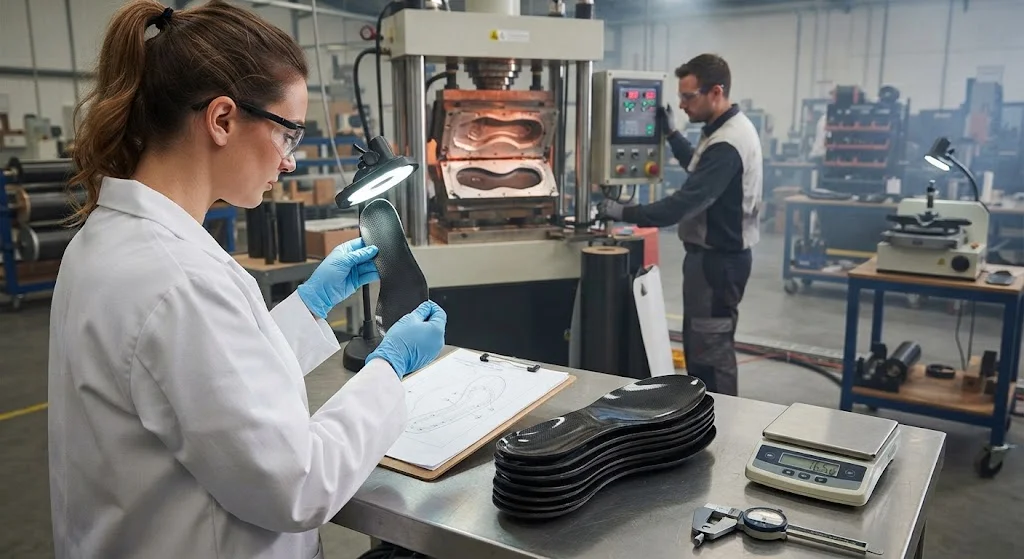
- Prepreg layup: Unidirectional prepreg layers are cut to pattern and stacked in a mold with fiber directions aligned to the plate's load path. Typical layups use 4-8 layers to reach the target 1.0-1.6 mm thickness.
- Molding and cure: The stack is placed in a heated compression mold, typically at 130-160°C under pressure for 5-15 minutes, curing the epoxy and consolidating the laminate into a void-free plate.
- Trimming and profiling: The cured plate is trimmed to final outline, and the rocker curvature is either molded in or shaped in a secondary profiling step depending on the tooling approach.
- Surface finishing: Edges are smoothed to prevent delamination during flexing, and the surface may be lightly sanded where it bonds to the midsole foam.
- Quality inspection: Plates are checked for thickness, weight, and visual defects; batch samples undergo flexure testing to confirm stiffness and fatigue behavior.
The molding approach — rather than the fiber grade — is the main cost driver. Compression molding with custom tooling requires investment but delivers consistent parts at high volume, which is why the technology scaled from elite racing to mass-market daily trainers. Lower-cost shoes use thinner plates or simpler geometries, but the core process is the same across the price spectrum.
Material Specifications That Matter
For a brand sourcing carbon fiber plate running shoes components, four specifications dominate the decision: thickness tolerance, fiber volume fraction, flexural modulus, and fatigue performance. Thickness tolerance matters because a plate that varies by ±0.1 mm across the part changes the shoe's flex characteristics; quality suppliers hold ±0.05-0.1 mm. Fiber volume fraction in the 55-65% range ensures the plate has enough fiber to carry the load without relying on resin, which is weaker and more brittle.
Flexural modulus is the number most often quoted because it directly controls how stiff the shoe feels. A racing plate runs in the 120-150 GPa range; a daily trainer plate may run 100-130 GPa. Fatigue performance is the least visible but most important for safety: the plate flexes tens of millions of times over a shoe's life, and a plate that delaminates or cracks mid-run is a product failure. Reputable suppliers validate plates with repeated flexure cycling into the millions of cycles.
Quality Control and Consistency
Consistency between plates — not just within one batch but across production runs — is what separates a professional composite athletic footwear supplier from a hobby operation. A shoe brand assembles thousands of pairs per model, and if plate stiffness varies by 15% between batches, the shoes feel different underfoot even though they look identical. Quality control therefore centers on three checks: dimensional (thickness and weight per plate), mechanical (flexural modulus on a sample basis), and visual (surface and edge defects).
For buyers evaluating suppliers, the practical signals are documentation and process control. Ask for the fiber grade, the resin system, the fiber volume fraction target and its tolerance, and fatigue test data. A supplier that can state these numbers and produce batch records is operating to a real specification; one that describes the plate only as "carbon fiber" is selling an unknown. The same discipline applies to the carbon fiber shoe insert used in orthotics and aftermarket insoles, where claims of carbon fiber content should be backed by actual material data.
Frequently Asked Questions
What is a carbon fiber plate running shoe?
A carbon fiber plate running shoe embeds a thin, curved carbon fiber plate in the midsole. The plate stores and returns energy during the gait cycle, acting as a lever that improves running economy by roughly 1-4% at race pace. Plates are typically 1.0-1.6 mm thick and weigh 15-30 grams.
How is a CFRP running plate manufactured?
Most running plates are made from unidirectional carbon fiber prepreg stacked in a compression mold, cured at 130-160°C under pressure for 5-15 minutes, then trimmed and profiled to final geometry. The process is essentially the same small-scale version of aerospace composite molding.
What material specifications matter for a running shoe plate?
The key specifications are thickness tolerance (±0.05-0.1 mm), fiber volume fraction (55-65%), flexural modulus (100-150 GPa depending on shoe type), and fatigue performance validated by millions of flexure cycles. Fiber grade is typically T700-class for the balance of strength, stiffness, and cost.
Do carbon fiber shoe inserts in orthotics really contain carbon fiber?
Many aftermarket insoles and orthotics claim carbon fiber content. Genuine inserts use a thin composite plate, but claims should be backed by material data — fiber grade and construction. Some products use a carbon-look cosmetic layer over plastic, which is not the same as a structural carbon fiber shoe insert.
Conclusion
Carbon fiber plate running shoes work because a thin, curved composite plate genuinely returns energy during the gait cycle, and the manufacturing process that produces the plate — prepreg layup, compression molding, trimming, and fatigue validation — is what determines whether the shoe performs consistently. Material specifications such as thickness tolerance, fiber volume fraction, and flexural modulus separate a factory-grade CFRP running plate from a decorative carbon fiber shoe insert, and those same numbers should guide any sourcing decision in composite athletic footwear.
YongXian manufactures carbon fiber plates and components for athletic footwear, including CFRP running plates and shoe inserts with controlled thickness, flexural performance, and batch test data. Explore our carbon fiber product range or contact our team to discuss plate specifications for your product.
Part of topic
Related Articles
- Carbon Fiber Sheets for Sale: A Buyer Checklist for Thickness, Weave and Finish
- Carbon Fiber Tubes for Sale: Spec Sheet Fields That Actually Matter
- Carbon Fiber Sheets Near Me: Local Dealers and Quick Turnaround Procurement
- Carbon Fiber Tubes Near Me: Local Stock Availability and Same-Day Delivery Options
- Carbon Fiber Plate Orthotic: Lightweight Prosthetic and Medical Device Applications
- Carbon Fiber Sheets 6mm: Specifications, Load Ratings and Application Guide
Interested in Our Products?
Contact our team for competitive pricing and technical specifications.
Get a QuoteRelated Products

Carbon Fiber Plate — 3K Twill T700 3.0mm
Medium-thickness 3.0mm carbon fiber plate offering significantly higher load capacity while maintaining attractive 3K twill finish. Suitable for structural brackets, reinforcement plates, and load-bearing panels.

Carbon Fiber Plate — 3K Twill T700 1.5mm
Thin 1.5mm carbon fiber plate with 3K twill weave surface. Lightweight and stiff, commonly used for covers, panels, drone bodies, and applications requiring a premium aesthetic appearance.

Square Carbon Fiber Tube — 3K Twill T700
Square cross-section carbon fiber tube manufactured with 3K twill weave for torsional strength. Preferred for structural frames, trusses, and support columns where rectangular geometry offers design flexibility.
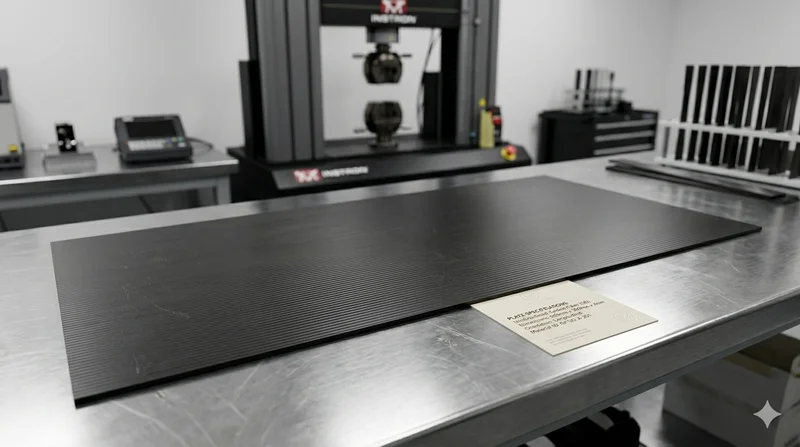
Carbon Fiber Plate — UD Unidirectional T700
Unidirectional carbon fiber plate with all fibers oriented in a single direction for maximum strength along the fiber axis. Essential for structural reinforcements, splints, and applications where load direction is predictable.
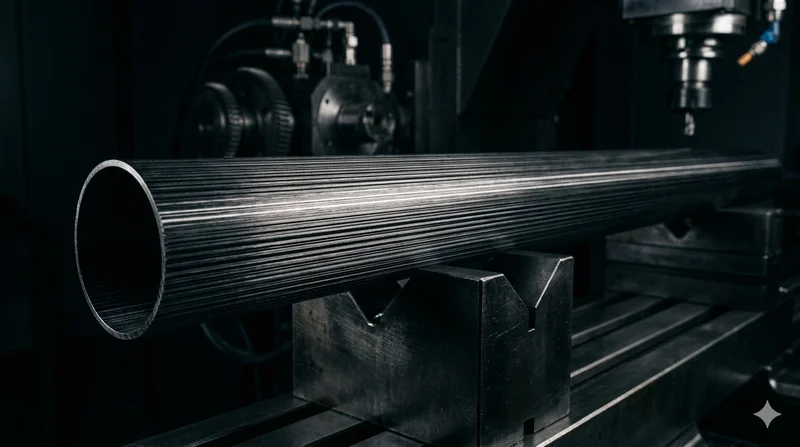
Round Carbon Fiber Tube — UD Unidirectional T700
Unidirectional (UD) round tube with all fibers aligned axially for maximum longitudinal stiffness. Ideal for applications requiring high bending rigidity with minimal weight, such as shafts, struts, and structural reinforcements.