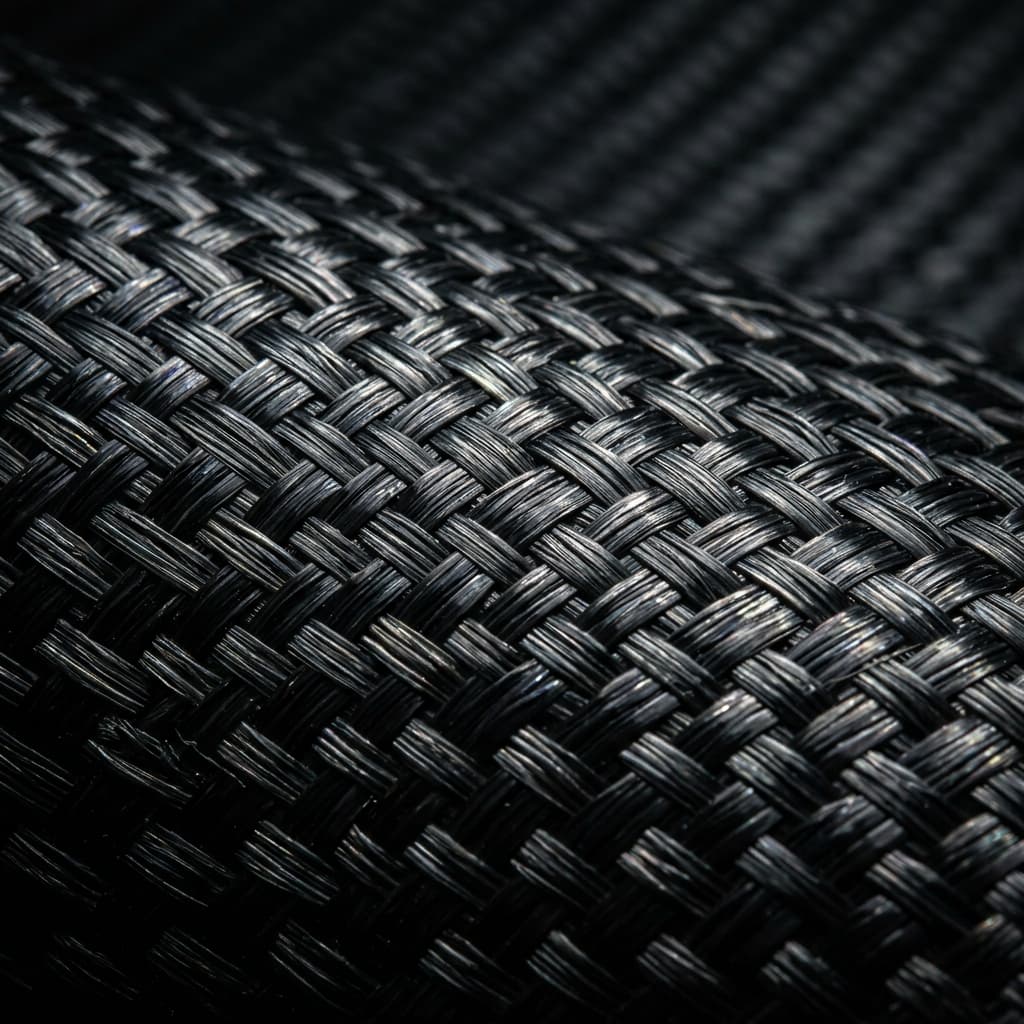
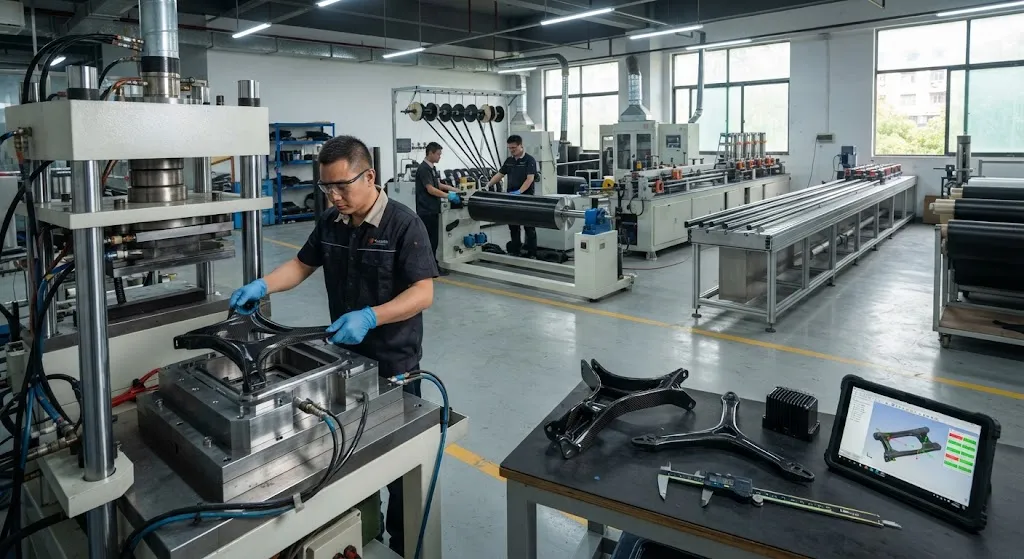
Carbon fiber parts manufacturing is the bridge between raw carbon fiber and the finished components used in aerospace, automotive, robotics and industrial equipment. The term covers a family of processes — prepreg autoclave curing, resin transfer molding, compression molding, filament winding, pultr
Introduction
Carbon fiber parts manufacturing is the bridge between raw carbon fiber and the finished components used in aerospace, automotive, robotics and industrial equipment. The term covers a family of processes — prepreg autoclave curing, resin transfer molding, compression molding, filament winding, pultrusion and bladder molding — and the right choice depends on part geometry, production volume, surface finish and budget. For buyers researching carbon fiber parts manufacturing suppliers, the process decision matters more than any other single factor, because it drives both mechanical performance and unit cost.
This guide walks through each mainstream manufacturing method, compares their economics and capabilities, and explains what a production-ready supplier should deliver — from design for manufacturability through tooling, quality testing and serial production.
The Core Processes in Carbon Fiber Parts Manufacturing
Every carbon fiber part manufacturing process combines carbon fiber reinforcement with a polymer matrix, but they differ in how the fiber is placed, how the resin is introduced, and how the part is cured. The table below summarises the methods a buyer is most likely to encounter.
| Process | How It Works | Typical Volume | Cost per Part | Best For |
|---|---|---|---|---|
| Prepreg + autoclave | Pre-impregnated fiber is laid up on a tool, vacuum-bagged and cured under heat and pressure | Low to medium | Highest | Aerospace and high-performance parts with tight tolerances |
| Resin transfer molding (RTM) | Dry fiber preform is placed in a closed mold and resin is injected under pressure | Medium | Mid-high | Complex 3D shapes, both-sided surface finish |
| Compression molding | Sheet or bulk molding compound is pressed in a heated matched die | High | Low at scale | Automotive panels, brackets, high-rate parts |
| Filament winding | Continuous fiber is wound over a rotating mandrel and cured | Medium | Mid | Tubes, shafts, pressure vessels |
| Pultrusion | Continuous fiber is pulled through a heated die to form constant profiles | Very high | Lowest | Rods, tubes, beams, rails |
Prepreg autoclave delivers the best mechanical consistency and surface quality, which is why it dominates flight-critical aerospace parts. RTM balances shape complexity with repeatable quality and is common in automotive and industrial housings. Compression molding is the workhorse for high-volume automotive and consumer parts where cycle time dominates. Filament winding and pultrusion cover long, constant-section parts at much lower cost than molded alternatives.
Carbon Fiber Parts Manufacturing: How to Choose a Process
The process choice is a trade-off across four variables — geometry, volume, surface requirement and load case. A practical way to narrow the field is to ask three questions:
- Is the part constant in cross-section? If yes, pultrusion or filament winding will almost always beat molding on cost and lead time.
- What is the annual volume? Above roughly 10,000 parts per year, compression molding or high-pressure RTM becomes economical; below 500 parts, prepreg or low-pressure RTM makes more sense.
- Is the surface appearance critical? Class-A automotive surfaces need matched metal tooling, which means RTM or compression molding; structural interiors tolerate bagged prepreg surfaces.
The load case also matters: unidirectional loads favour pultruded or wound architectures, multi-axial loads favour woven fabrics and molded layups. A good carbon fiber parts manufacturer will push back on the process suggestion if the geometry and volume do not fit, and recommend the method that hits the cost target instead.
Design for Manufacturing: What the Supplier Needs From You
Successful carbon fiber parts manufacturing starts before any fiber is cut. Suppliers work from a defined set of inputs, and the quality of those inputs determines how fast a project moves from prototype to production. The standard package includes a 3D CAD model, a drawing with tolerances, the load and environmental conditions the part must survive, and the annual quantity. With these, an application engineer can select the fiber grade, resin system, layup sequence and process, then quote tooling and per-part cost.
Two design details deserve special attention. First, draft angles and radii: sharp internal corners trap air and create dry spots in RTM and compression molding, so generous radii improve fill and reduce defects. Second, tolerances: carbon fiber parts shrink slightly during cure and spring back after demolding, so suppliers hold dimensional tolerances of roughly ±0.1 to ±0.5 mm depending on process and feature size. Knowing these limits early prevents expensive tooling revisions later.
Tooling and Production Ramp-Up
Tooling is the largest one-time cost in carbon fiber parts manufacturing. Aluminum tools are common for medium volumes, steel for high-volume compression molding, and carbon fiber or Invar tools for autoclave parts where thermal expansion must match the part. Tooling lead times typically run four to twelve weeks, and buyers should treat the tooling investment as part of the total project cost rather than comparing only per-part prices.
A reputable supplier validates tooling with a first-article inspection: the first parts are measured against the drawing, test coupons are cut from the same production run, and mechanical tests confirm modulus, strength and void content before serial production starts. This step is where most quality problems are caught cheaply — fixing a tool costs far less than recalling a production batch.
Quality Control and Certification
Quality control in carbon fiber parts manufacturing covers three layers: incoming material verification, in-process control and final part testing. Incoming checks confirm fiber areal weight, resin content and shelf life of prepreg. In-process control tracks cure temperature and pressure profiles against the qualified process specification. Final testing typically includes ultrasonic inspection for voids and delamination, dimensional measurement, and destructive testing of process coupons.
- Ultrasonic inspection detects internal voids and delamination that are invisible on the surface.
- Mechanical coupons — tensile, flexural and compression samples from each batch confirm the material meets specification.
- Certification — aerospace suppliers hold AS9100 and often NADCAP; industrial suppliers commonly hold ISO 9001 with material certificates on every shipment.
For buyers, the practical ask is simple: request the quality manual, the inspection reports from the first article, and the material certificates that accompany each order.
Cost Drivers and What to Expect
Unit cost in carbon fiber parts manufacturing is dominated by material, labor and tooling amortisation, in proportions that vary sharply by process. The table below shows typical cost structures for molded parts.
| Cost Component | Prepreg Autoclave | RTM | Compression Molding |
|---|---|---|---|
| Material share | 40-55% | 30-45% | 25-40% |
| Labor share | 30-40% | 20-30% | 10-20% |
| Tooling amortisation | 5-15% | 15-25% | 20-35% |
| Typical cycle time | 2-6 hours | 30-90 minutes | 5-20 minutes |
Material dominates autoclave parts because aerospace-grade prepreg is expensive and layup is labor-intensive. Tooling dominates compression molding because matched steel dies are costly but pay off at high volume. When comparing quotes from carbon fiber parts manufacturing suppliers, ask for the breakdown — a low per-part price with a high tooling charge can be the right choice at volume, and the reverse for prototypes.
Frequently Asked Questions
How much does carbon fiber parts manufacturing cost?
Per-part cost ranges widely: pultruded profiles can cost a few dollars per metre at volume, while autoclave-cured aerospace parts run from tens to hundreds of dollars each depending on size and complexity. Tooling adds a one-time cost of roughly $2,000 to $50,000 or more per mold. The cheapest way to compare is to send the same drawing to several carbon fiber parts manufacturers and ask for a tooling quote and a per-part quote at your annual volume.
How long does it take to get a carbon fiber part into production?
A typical timeline is one to three weeks for design review and quoting, four to twelve weeks for tooling, and one to three weeks for first articles and testing. Total time to serial production is usually eight to eighteen weeks from a signed drawing. Prototyping with 3D-printed tools or hand layup can compress the first samples to two to four weeks, at the cost of lower surface quality and higher per-part price.
Can carbon fiber parts manufacturing achieve tight tolerances?
Yes, but within process limits. Pultruded and filament-wound parts hold ±0.1 to ±0.25 mm on diameter and wall thickness when the tooling is matched to the fibre architecture. Molded parts hold ±0.1 to ±0.5 mm depending on feature size and cure shrinkage. Where tolerances below these ranges are needed, suppliers machine critical surfaces after cure — typically on 5-axis CNC — which is common for mating faces and fastener holes.
Conclusion
Carbon fiber parts manufacturing is a process decision before it is a supplier decision. Define the geometry, volume, surface and load requirements, then match them to the process — pultrusion and winding for constant sections, RTM and compression molding for complex shapes at volume, and prepreg autoclave for the highest performance. Validate the supplier's quality system, inspect the first article, and compare tooling plus per-part cost rather than unit price alone.
YongXian manufactures pultruded and filament-wound carbon fiber parts with export documentation, material certificates and custom tooling support. View our carbon fiber product range or request a quote with your drawing and annual volume.
Related Articles
- Carbon Fiber Plate Amazon: Complete Guide
- Carbon Fiber And PU Case: Complete Guide
- Carbon Fiber Parts For Cars: Complete Guide
- Carbon Fiber Manufacturing Companies: Complete Guide
- Carbon Fiber Sheets for Sale: A Buyer Checklist for Thickness, Weave and Finish
- Carbon Fiber Plate Running Shoes: Manufacturing Process and Material Specifications
Interested in Our Products?
Contact our team for competitive pricing and technical specifications.
Get a QuoteRelated Products

Carbon Fiber Plate — 3K Twill T700 3.0mm
Medium-thickness 3.0mm carbon fiber plate offering significantly higher load capacity while maintaining attractive 3K twill finish. Suitable for structural brackets, reinforcement plates, and load-bearing panels.

Carbon Fiber Plate — 3K Twill T700 1.5mm
Thin 1.5mm carbon fiber plate with 3K twill weave surface. Lightweight and stiff, commonly used for covers, panels, drone bodies, and applications requiring a premium aesthetic appearance.

Square Carbon Fiber Tube — 3K Twill T700
Square cross-section carbon fiber tube manufactured with 3K twill weave for torsional strength. Preferred for structural frames, trusses, and support columns where rectangular geometry offers design flexibility.
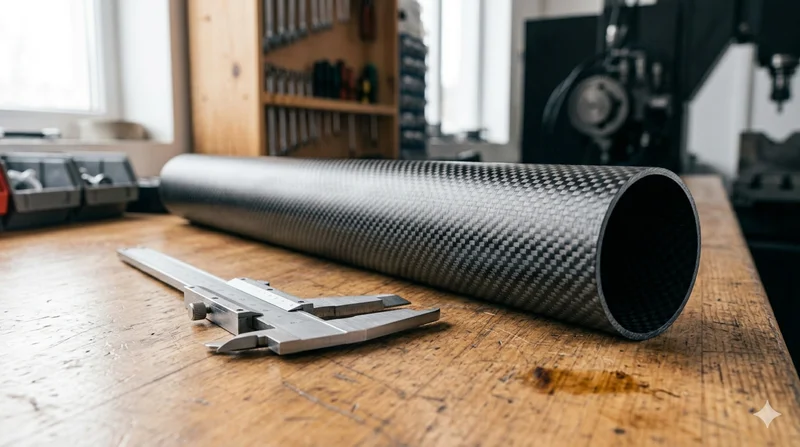
Round Carbon Fiber Tube — 3K Plain Weave T700
Standard round carbon fiber tube manufactured from Toray T700 grade fiber with 3K plain weave. Offers balanced strength and stiffness for general industrial applications including robotics, automation, sports equipment, and aerospace structures.
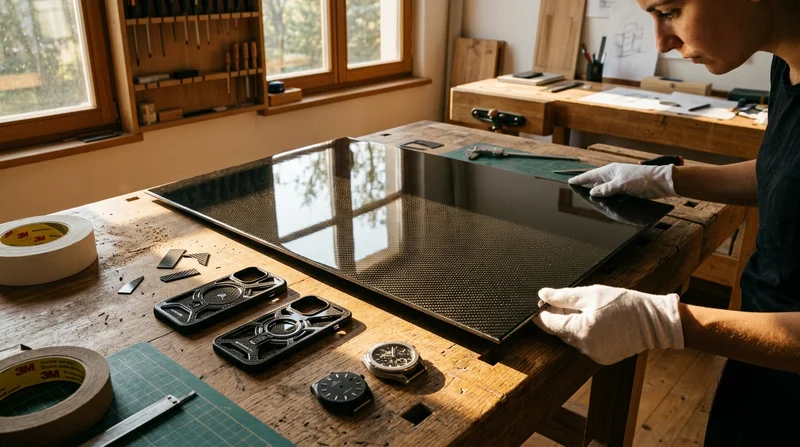
Carbon Fiber Plate — High-Gloss Decorative
High-gloss decorative carbon fiber plate with a mirror-like surface finish. The glossy coating enhances the visible 3K twill weave, creating a premium aesthetic for consumer-facing applications. Lightweight yet stiff, available in thin gauges for easy cutting and forming.