Selecting a carbon fiber sheet supplier is one of the highest-leverage decisions a composite buyer makes, because the supplier determines not only the material price but also the dimensional accuracy, batch consistency, and lead time of every downstream process. A direct factory supplier — one that
Introduction
Selecting a carbon fiber sheet supplier is one of the highest-leverage decisions a composite buyer makes, because the supplier determines not only the material price but also the dimensional accuracy, batch consistency, and lead time of every downstream process. A direct factory supplier — one that weaves or laminates the sheet itself rather than reselling another mill's production — changes the economics in two ways: direct factory pricing strips out distributor margins, and in-house cut-to-size services remove the secondary handling that inflates both cost and schedule.
This article explains how to evaluate a carbon fiber sheet supplier for direct purchasing, what factory-direct pricing actually includes and excludes, which cut-to-size capabilities matter for common applications, and the verification steps that protect the buyer before and after the order. It is written for purchasing managers and engineers sourcing carbon fiber plate and sheet products for production programs.
What to Look for in a Carbon Fiber Sheet Supplier
A carbon fiber sheet supplier is not interchangeable with a carbon fiber plate factory, even though the terms are often used together. A factory manufactures the laminate from raw fiber and resin; a supplier may only warehouse and cut material produced elsewhere. When the buyer's application is structural, the distinction matters because the factory controls the fiber grade, the layup, the cure cycle, and the quality data attached to each batch. The evaluation checklist below separates the two clearly:
- Manufacturing depth: Does the supplier mold or laminate its own sheets? Ask for the production process and the location of the presses or autoclaves. A supplier that cannot show its own laminating line is a trader, regardless of marketing language.
- Material traceability: Every sheet should carry a batch number that maps to fiber certificates, resin certificates, and cure records. Request a sample batch report before committing volume.
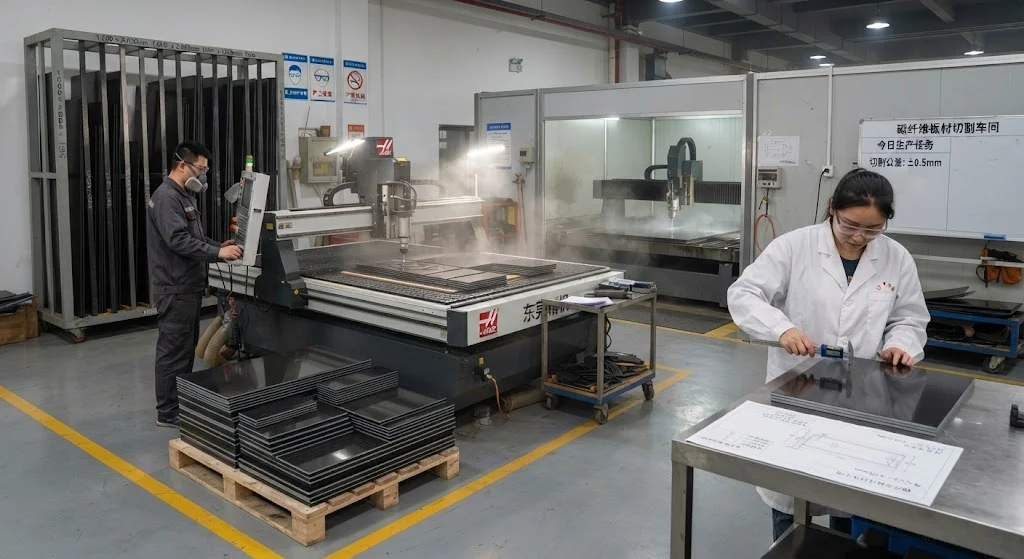
- In-house machining and cutting: Confirm whether the supplier operates its own CNC routers, waterjet cutters, and saws, or whether cutting is outsourced. In-house capability shortens cut-to-size lead times from weeks to days and keeps tolerances under one set of responsibility.
- Testing and documentation: Look for in-house or third-party testing of tensile, flexural, and thickness properties, plus certificates of conformance on every shipment.
- Minimum order flexibility: Direct factories often accept smaller orders than distributors because they control the whole production chain; verify the MOQ structure rather than assuming it.
Direct Factory Pricing: What It Includes and What It Does Not
Direct factory pricing for carbon fiber sheets is typically 15-35% lower than distributor pricing on equivalent material, because the factory does not pay the distributor's markup. But the comparison is only valid when the quotes are aligned on the same specification. Factory quotes are usually ex-works (EXW) or FOB, which means freight, insurance, customs clearance, and import duties are excluded and must be added to the landed cost. Distributor quotes are frequently delivered-duty-paid (DDP), which bundles all of those costs into a single number that looks higher but includes more.
| Cost Component | Direct Factory Quote | Distributor Quote |
|---|---|---|
| Material price per m² | Base (15-35% lower) | Marked up |
| Cut-to-size labor | Often included or low | Usually extra |
| Freight and insurance | EXW/FOB, added separately | Often bundled (DDP) |
| Customs and duties | Buyer's responsibility | Often bundled (DDP) |
| Minimum order quantity | 100-300 sheets typical | Smaller, per-sheet possible |
| Custom thickness/width | Possible, factory-controlled | Limited to stock |
The practical rule is to compare landed cost, not quote price. A distributor quote at DDP may still be competitive for a one-off purchase of a few sheets, because the factory's freight and duty costs are spread over a small quantity. The factory-direct advantage grows with volume, with repeat orders, and with any requirement for custom dimensions or material documentation that a distributor cannot supply.
Cut-to-Size Services from a Carbon Fiber Sheet Supplier
A composite sheet manufacturer that offers cut-to-size services eliminates a whole step from the buyer's supply chain: the buyer does not need to buy a full 1,000 × 1,000 mm or 1,000 × 2,000 mm panel and pay a local machine shop to cut it. Factory cut-to-size work is typically priced per cut or per square meter and covers several standard operations:
- Rectangular cutting: Straight cuts to specified length and width on panel saws, with tolerances of ±0.5-1.0 mm on each edge.
- CNC routing: Complex profiles, holes, pockets, and edge features machined to ±0.1-0.2 mm from 3D CAD files supplied by the buyer.
- Waterjet cutting: Clean, heat-free profiles for thick laminates, ideal for edges that will be visible in the finished part.
- Edge sealing: Sealing of machined edges with thin CA or epoxy to prevent fiber wicking and delamination in service.
The saving is both monetary and temporal. A buyer who sources raw panels and outsources cutting pays the machine shop's overhead, waits for the shop's queue, and carries the risk of a cutting error that voids the material. With factory cut-to-size, one supplier owns the material and the tolerance, and the buyer receives parts that are ready for assembly or finishing.
Verification Steps Before Ordering
Before committing volume to any carbon fiber sheet supplier, a buyer should complete four verification steps. First, request and inspect a material certificate and a batch test report for the specific fiber grade and resin system to be ordered, confirming that the values match the datasheet. Second, order a sample or small pilot lot and measure it independently: check thickness with a micrometer at several points, check squareness, and weigh the panel to confirm density and fiber volume fraction. Third, verify the cut-to-size tolerance on actual delivered parts with calipers, not by trusting the quote. Fourth, confirm the supplier's response path for quality claims: a direct factory that will replace defective material or credit the invoice is worth more than a marginally cheaper quote with no accountability.
These steps are cheap relative to the cost of a failed production batch. A laminate that arrives with the wrong fiber volume fraction or out-of-tolerance thickness can halt a line and waste downstream machining hours that cost far more than the sheet itself. The supplier's willingness to share process data, batch records, and test results is itself a signal of manufacturing depth. For buyers who need a CFRP sheet direct supplier rather than a stock trader, this verification routine is what separates a production partner from a reseller.
Frequently Asked Questions
How much can I save by buying carbon fiber sheets directly from a factory?
On equivalent material specification, direct factory pricing is typically 15-35% lower than distributor pricing before freight. After adding freight, insurance, and duties, the landed-cost saving for regular volume purchases is usually 10-20%. The saving grows when the order includes cut-to-size work, because the factory does the cutting internally instead of the buyer paying a local machine shop, and when the buyer places repeat orders that amortize tooling and setup. For one-off purchases of a few sheets, the landed-cost difference can shrink to near zero, which is why the direct route pays off most clearly for production programs rather than single buys.
What is the typical minimum order quantity when buying factory-direct?
Minimum order quantities vary with the manufacturing route. Laminated sheet production runs are typically quoted at 100-300 sheets per order, though many factories accept a pilot order of 10-20 sheets to validate quality before the full commitment. Cut-to-size and CNC work often carry a smaller MOQ because the labor is separate from the material run. Some suppliers offer a mixed MOQ: a minimum annual volume with monthly releases, which suits buyers with continuous but moderate consumption. It is worth asking explicitly, because many factory sales teams quote the production MOQ by default when a smaller pilot path exists.
How do I verify that a supplier is a genuine carbon fiber sheet factory and not a trader?
Ask three questions. First, where is the laminating or molding line, and can you visit it or receive a video tour? Second, what equipment produces your sheets, and what is the cure cycle for the standard product? Third, what batch data is attached to each shipment, and can you provide a sample batch report now? A genuine factory answers all three from its own operation; a trader typically answers with brand names and distributor language. Supporting signals include in-house testing equipment, published process certifications, and the ability to produce custom thicknesses or weaves, which only a factory can do economically.
Conclusion
A carbon fiber sheet supplier that operates its own factory and cut-to-size line delivers two compounding advantages: direct factory pricing that reduces material cost by 15-35% before freight, and in-house cutting that shortens lead times and removes the tolerance risk of outsourced machining. The evaluation checklist, landed-cost comparison, and verification steps in this guide give a buyer the tools to separate a genuine composite sheet manufacturer from a reseller, and to protect the program once the order is placed.
YongXian manufactures carbon fiber sheets in-house and offers direct factory pricing with cut-to-size, CNC machining, and edge sealing services. Browse our carbon fiber sheet and plate range or contact our engineering team for a factory-direct quotation and a sample batch for your application.
Part of topic
Related Articles
- Carbon Fiber Sheet for Sale: In-Stock Inventory and Custom Order Lead Times
- Carbon Fiber Sheet Roll: Continuous Roll Supply for High-Volume Production
- Carbon Fiber Parts Houston: Texas Manufacturing Hub and Energy Sector Demand
- Carbon Fibre for Sale: Reading Listings, Grades and Lead Times
- Carbon Fiber Near Me: Why Local Sourcing Beats Cross-Border for Prototyping
- Carbon Fiber Rod Blanks: Supply Chain and Custom Cutting Services
Interested in Our Products?
Contact our team for competitive pricing and technical specifications.
Get a QuoteRelated Products
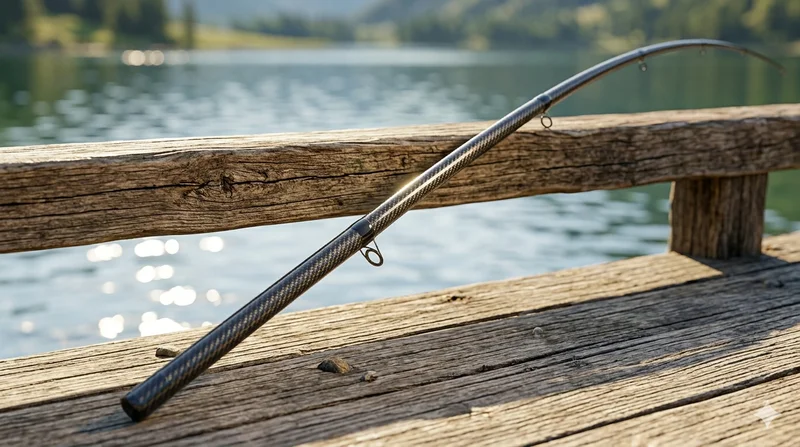
Carbon Fiber Fishing Rod Blank
High-quality carbon fiber fishing rod blank manufactured from multiple grades of Toray carbon fiber cloth. Available in a wide range of lengths, powers, and actions for freshwater and saltwater applications. Suitable for OEM rod building.

Carbon Fiber Plate — 3K Twill T700 3.0mm
Medium-thickness 3.0mm carbon fiber plate offering significantly higher load capacity while maintaining attractive 3K twill finish. Suitable for structural brackets, reinforcement plates, and load-bearing panels.

Carbon Fiber Plate — 3K Twill T700 1.5mm
Thin 1.5mm carbon fiber plate with 3K twill weave surface. Lightweight and stiff, commonly used for covers, panels, drone bodies, and applications requiring a premium aesthetic appearance.
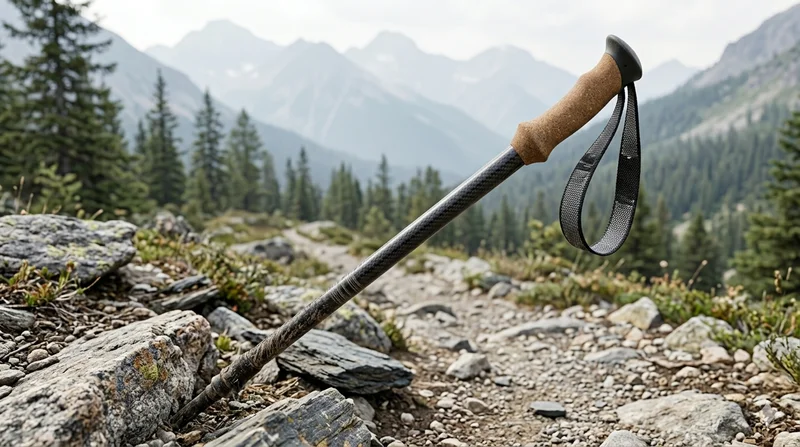
Carbon Fiber Trekking Pole
Lightweight carbon fiber trekking pole manufactured from high-grade carbon fiber tube. Weighs only 160g per pole while providing superior shock absorption and durability for hiking, trail running, and backpacking.

Square Carbon Fiber Tube — 3K Twill T700
Square cross-section carbon fiber tube manufactured with 3K twill weave for torsional strength. Preferred for structural frames, trusses, and support columns where rectangular geometry offers design flexibility.