A carbon fiber sheet roll is the most efficient delivery format for composite material in production environments. Unlike cut panels, which are limited by their original plate dimensions, a carbon fiber sheet roll feeds continuous material into automated cutting tables, AFP heads, and lamination lin
Introduction
A carbon fiber sheet roll is the most efficient delivery format for composite material in production environments. Unlike cut panels, which are limited by their original plate dimensions, a carbon fiber sheet roll feeds continuous material into automated cutting tables, AFP heads, and lamination lines without interruption. For manufacturers running high-volume programs, the difference between buying cut sheets and buying carbon fiber sheet roll material is measured in waste percentage, cutting throughput, and cost per square meter.
This article explains what carbon fiber sheet roll supply involves: the common roll formats and their dimensions, the quality controls that separate reliable roll suppliers from inconsistent ones, how to specify and store rolled material, and how to structure a sourcing agreement for continuous production. It is written for production engineers, purchasing managers, and composite manufacturers who need predictable material flow at scale.
Roll Formats: What You Can Buy as a Carbon Fiber Sheet Roll
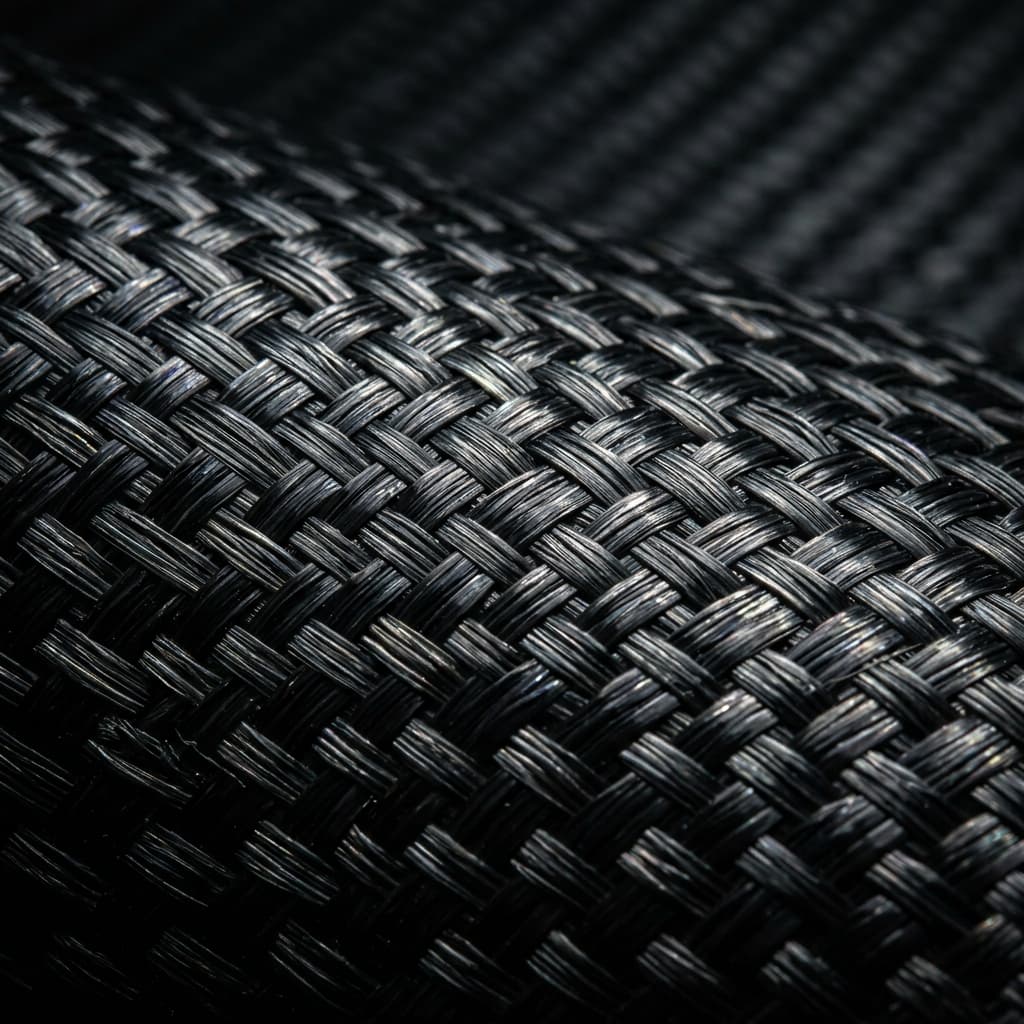
Manufacturers buy rolled carbon fiber in three primary formats, each serving a different process. The first is dry woven fabric: carbon fiber tow woven into plain, twill, or satin weaves and supplied without resin. The second is unidirectional sheet, where all fibers run in one direction, often stabilized with a light thermoplastic or epoxy binder so the roll holds together during cutting. The third is prepreg: woven or unidirectional sheet pre-impregnated with resin and supplied on rolls with a protective film, stored frozen until use.
| Format | Typical Width | Roll Length | Resin Content | Storage |
|---|---|---|---|---|
| Dry woven fabric | 100 cm / 125 cm | 50-100 m | None (added at infusion) | Ambient, dry |
| Unidirectional sheet | 50-150 cm | 100-300 m | 0-5% binder | Ambient, dry |
| Prepreg | 50-150 cm | 40-100 m | 32-42% (uncured) | -18°C frozen |
| UD tape (unidirectional) | 0.6-30 cm | 200-500 m | 32-40% (uncured) | -18°C frozen |
Roll width is the single most important dimension to match to your cutting table or layup width. A roll that is 5 cm wider than the intended part yields edge trim that is pure waste; a roll that is narrower forces additional splices. For this reason, carbon fiber sheet roll buyers should negotiate custom widths where possible rather than accepting a stock width that does not match the cutting geometry.
Why Rolls Beat Cut Sheets in High-Volume Production
The economic case for carbon fiber sheet roll supply rests on three measurable advantages over cut-to-size panels:
- Nesting efficiency: Continuous material allows true 2D nesting on automated cutting tables, which can improve material utilization by 8-15% compared with cutting from fixed-size plates, where the boundary of each plate constrains the layout.
- Throughput: A roll-fed cutting table runs continuously, while a cut-sheet line stops each time a new panel is loaded and aligned. Typical roll-fed lines achieve 20-30 m² per hour of cut, shaped parts, versus 8-12 m² per hour for plate-fed operations.
- Inventory simplification: One 100 m roll replaces dozens of plate SKUs, reducing warehouse space, handling time, and the risk of stocking the wrong thickness.
- Consistency: A single roll carries a single production lot, which simplifies traceability and reduces the mechanical property scatter that comes from mixing multiple plate batches in one structure.
The trade-off appears at low volumes. Cut sheets are the right choice for prototyping, one-off repairs, and small-batch production where a 100 m roll would sit unused for months. The crossover point for most manufacturers is roughly 200-300 m² of material per month: below this, cut sheets minimize capital tied up in inventory; above it, carbon fiber sheet roll material pays for itself in waste reduction and labor savings.
Quality Controls That Define a Reliable Roll Supplier
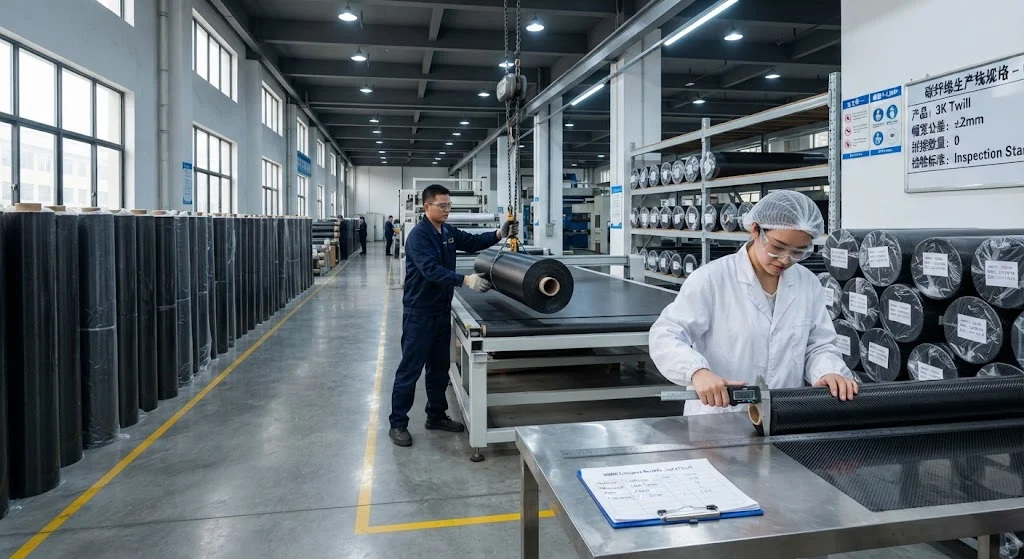
Not all carbon fiber sheet roll suppliers deliver the same product quality, and the differences appear in ways that affect the production line directly. The first control is width tolerance. A reputable supplier holds roll width within ±2 mm across the full length; cheaper material can wander by 5-10 mm, which jams cutting tables and ruins edge alignment. The second is splice count. Most roll suppliers quote a maximum number of internal splices per 100 m roll, typically 0-2, and should mark splice locations so the cutting software can skip them.
The third control is tension and roll density. A roll wound too loosely distorts during handling and unwinds unevenly; a roll wound too tightly can crush the fiber at the core. Buyers should specify a minimum roll weight or density per linear meter, and suppliers should provide a winding report with each shipment. For prepreg, the critical additional controls are resin content uniformity, measured by solvent extraction sampling, and out-time tracking, because the material is usable only within a defined number of days at room temperature before it must be returned to the freezer or discarded.
Sourcing Strategy for Carbon Fiber Sheet Roll Material
For continuous production, the sourcing agreement matters as much as the material specification. The standard approach is a framework agreement with a rolling schedule: the buyer commits to an annual volume, and the supplier releases material monthly against a four-to-six week forecast. This structure secures capacity without forcing the buyer to hold a year of inventory. Typical minimum order quantities for rolls are 100-500 linear meters per format, though suppliers with continuous weaving or slitting capacity can often accept smaller pilot orders. Whether a program consumes carbon fiber roll material on an automated cutting line or feeds dry cloth into infusion tooling, the supplier's slitting capability and width options matter as much as the base price, and a CFRP sheet roll with a documented winding report protects the line from costly stoppages. For infusion and wet-layup processes, a composite fabric roll with consistent permeability and a low splice count is the safer choice than a bargain roll with undocumented joints.
Lead time is the second lever. Standard woven fabric rolls are typically available in two to four weeks; unidirectional sheet rolls in three to five weeks; and prepreg in four to eight weeks because the resin system must be mixed and coated to order. Buyers who maintain a two-month safety stock of their critical format absorb most of this variability, while custom widths, unusual weaves, and aerospace-grade resin systems push lead times to the upper end of these ranges. A reliable carbon fiber sheet roll supplier will publish these lead times, honor them in writing, and offer expedite options for schedule changes.
Handling and Storage Best Practices
Rolled carbon fiber has specific handling rules that protect both the material and the production line. Dry fabric and unidirectional sheet rolls should be stored horizontally on their ends, never stacked on their flat sides, to prevent edge crushing and distortion. Ambient storage should be below 25°C with relative humidity under 65%. Prepreg requires refrigerated storage at -18°C, and each roll should be tracked for out-time: the cumulative hours spent at room temperature, which typically cannot exceed 21-30 days for standard epoxy prepreg before the resin advances beyond processable viscosity.
On the cutting line, roll stands should be fitted with edge guides and tension control, and the unwinding speed should match the cutting table feed so the material never slackens or snags. These may sound like operational details, but they directly determine the defect rate that the buyer, not the supplier, absorbs. Specifying the storage and handling regime in the purchase agreement assigns the responsibility clearly and protects both parties.
Frequently Asked Questions
How much cheaper is carbon fiber sheet roll material than cut sheets per square meter?
On a pure material basis, rolled formats are typically 10-25% cheaper per square meter than equivalent cut-to-size panels, because the supplier avoids the cutting, edge finishing, and packaging labor that cut-sheet orders require. The larger saving is in production: roll feeding improves nesting utilization by 8-15% and raises cutting throughput two to three times, so the effective cost per usable part falls by 20-40% for high-volume programs. For low-volume users the saving disappears, because a roll that is only partially consumed ties up capital and floor space.
What is the minimum order quantity for a carbon fiber sheet roll?
Most suppliers set MOQs of 100-500 linear meters per format and width. Dry woven fabric is usually the most flexible, with some suppliers accepting 50 m pilot rolls; prepreg MOQs tend to be higher because each roll requires a dedicated resin batch and coating run. Custom widths below 50 cm often carry a slitting surcharge. Buyers planning a new program should request a pilot roll of 10-20 m first to validate width consistency, splice quality, and process compatibility before committing to the full MOQ.
How should a prepreg roll be handled if the freezer fails?
If a -18°C freezer fails, the roll must be moved to an alternate refrigerated space immediately. Standard epoxy prepreg can survive short interruptions of 2-4 hours at ambient temperature without measurable damage, but every hour outside the freezer counts against its out-time budget of typically 21-30 days. Log the interruption, keep the roll sealed in its vacuum bag, and verify residual tack and resin flow with a small test layup before using the roll in production. If the roll was already near the end of its out-time budget, the safest choice is to discard it, because advanced resin will not consolidate correctly in the autoclave or press.
Conclusion
Carbon fiber sheet roll supply is the right material strategy for manufacturers whose consumption exceeds roughly 200-300 m² per month. Roll formats deliver better nesting utilization, higher cutting throughput, simpler inventory, and tighter batch consistency, provided the buyer matches roll width to the cutting geometry and verifies width tolerance, splice count, and winding quality with each shipment. The remaining decisions, storage regime and sourcing structure, are straightforward once the format and lead time requirements are clear.
YongXian supplies carbon fiber sheet roll material in woven, unidirectional, and prepreg formats, with custom widths and stable lead times for production programs. Browse our carbon fiber sheet and roll products or contact our engineering team for a quotation on continuous roll supply for your production line.
Part of topic
Related Articles
- Carbon Fiber Sheet for Sale: In-Stock Inventory and Custom Order Lead Times
- Carbon Fiber Sheet Supplier: Direct Factory Pricing and Custom Cut-to-Size Services
- Carbon Fiber Parts Houston: Texas Manufacturing Hub and Energy Sector Demand
- Carbon Fibre for Sale: Reading Listings, Grades and Lead Times
- Carbon Fiber Near Me: Why Local Sourcing Beats Cross-Border for Prototyping
- Carbon Fiber Rod Blanks: Supply Chain and Custom Cutting Services
Interested in Our Products?
Contact our team for competitive pricing and technical specifications.
Get a QuoteRelated Products

Carbon Fiber Fishing Rod Blank
High-quality carbon fiber fishing rod blank manufactured from multiple grades of Toray carbon fiber cloth. Available in a wide range of lengths, powers, and actions for freshwater and saltwater applications. Suitable for OEM rod building.

Carbon Fiber Plate — 3K Twill T700 3.0mm
Medium-thickness 3.0mm carbon fiber plate offering significantly higher load capacity while maintaining attractive 3K twill finish. Suitable for structural brackets, reinforcement plates, and load-bearing panels.

Carbon Fiber Plate — 3K Twill T700 1.5mm
Thin 1.5mm carbon fiber plate with 3K twill weave surface. Lightweight and stiff, commonly used for covers, panels, drone bodies, and applications requiring a premium aesthetic appearance.

Carbon Fiber Trekking Pole
Lightweight carbon fiber trekking pole manufactured from high-grade carbon fiber tube. Weighs only 160g per pole while providing superior shock absorption and durability for hiking, trail running, and backpacking.

Square Carbon Fiber Tube — 3K Twill T700
Square cross-section carbon fiber tube manufactured with 3K twill weave for torsional strength. Preferred for structural frames, trusses, and support columns where rectangular geometry offers design flexibility.