A carbon fiber plate for foot orthotics sits at the intersection of clinical biomechanics and materials engineering: it must be thin enough to fit inside a shoe, stiff enough to control motion or return energy, and durable enough to survive millions of loading cycles. Clinicians specify plates for a
Introduction
A carbon fiber plate for foot orthotics sits at the intersection of clinical biomechanics and materials engineering: it must be thin enough to fit inside a shoe, stiff enough to control motion or return energy, and durable enough to survive millions of loading cycles. Clinicians specify plates for ankle-foot orthoses, fracture boots and accommodative insoles; sports brands embed thinner plates in running shoes to shift the rocker geometry of the midsole. Both fields draw from the same CFRP building blocks but demand different layups, thicknesses and finishing strategies. This guide explains how to design a carbon fiber plate for foot applications, from fiber architecture and thickness selection to edge radii, bonding and fatigue inspection, and compares carbon against the polypropylene and fiberglass plates it often replaces.
Carbon Fiber Plate for Foot Orthotics: Roles and Loading
In clinical orthotics the plate performs one of three mechanical jobs, and the job dictates the entire specification:
- Ground reaction control: Ankle-foot orthosis plates resist ankle plantarflexion during gait. Stiffness targets typically fall between 15 and 40 N/mm at the midfoot span, tuned to patient weight and motor control.
- Accommodation and offloading: Ulcer-risk and post-surgical insoles use thinner, more flexible plates to redistribute pressure without rigidly blocking motion.
- Energy management: Performance footwear plates act as a lever within the midsole foam, storing strain energy at midstance and releasing it at toe-off. Here the metric is bending stiffness about the forefoot rocker, not clinical range-of-motion blocking.
Across all three roles the design loop is the same: define the bending stiffness target, convert it to a plate geometry and layup, then verify against fatigue and fit constraints. Carbon fiber earns its place because specific stiffness — stiffness per unit mass — is roughly five times that of polypropylene and three times that of fiberglass at comparable plate thicknesses.
Materials and Layup: Choosing the Carbon Plate Build
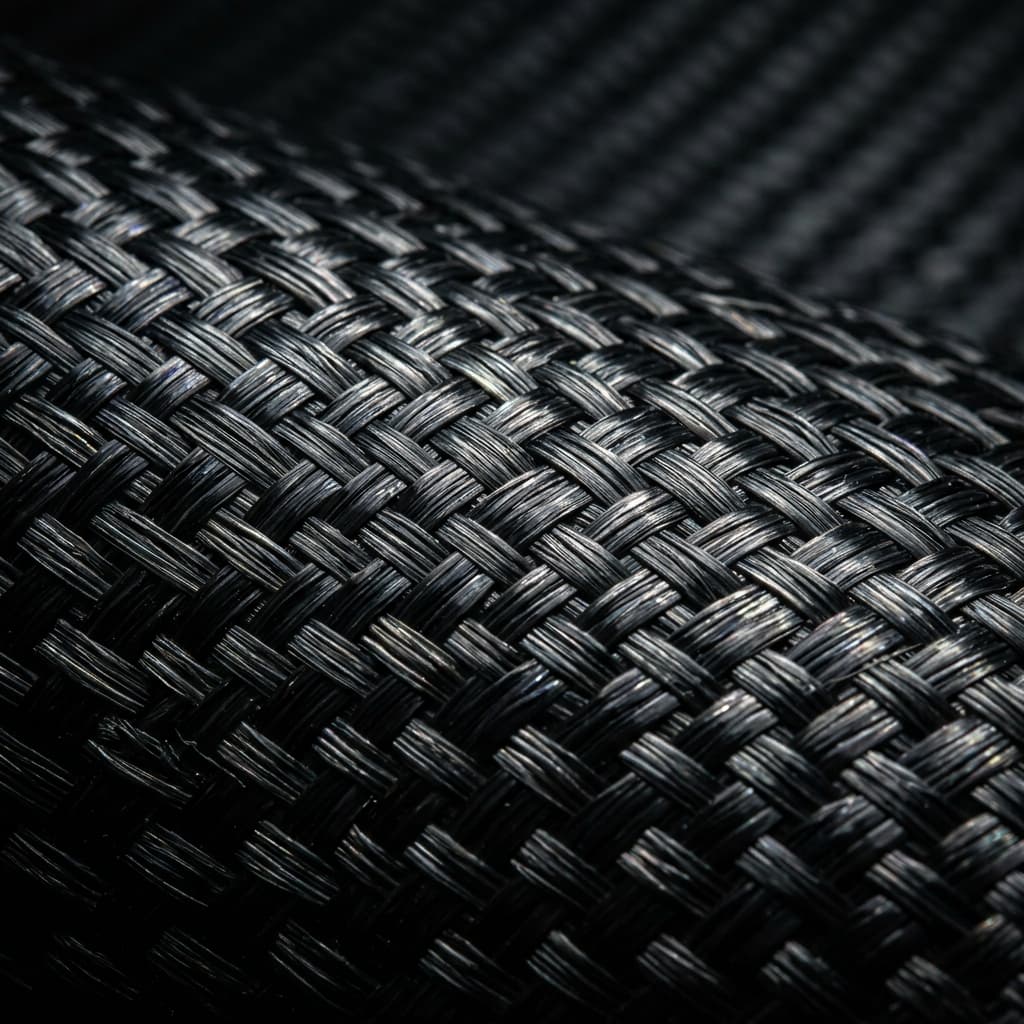
Orthotic and footwear plates almost always use unidirectional (UD) prepreg laid in a quasi-symmetric stack, because UD plies let the designer place stiffness precisely along the medial-lateral or proximal-distal axis. A typical clinical AFO plate uses 8 to 12 plies of 200 gsm T300-class UD carbon at 0/90 orientation, post-cured at 80 degrees C, landing at 1.6 to 2.4 mm finished thickness. Running-shoe plates run thinner — 0.6 to 1.5 mm — and often combine a UD spine with woven surfacing plies for damage tolerance.
| Property | Carbon UD Plate | Polypropylene Plate | Fiberglass Plate |
|---|---|---|---|
| Density | 1.55 g/cm³ | 0.90 g/cm³ | 1.85 g/cm³ |
| Flexural modulus | 70-110 GPa (0 deg laminate) | 1.2-1.8 GPa | 20-30 GPa |
| Typical clinical thickness | 1.6-2.4 mm | 3-5 mm | 2.5-4 mm |
| Mass of a 200 x 80 mm plate | 50-75 g | 48-72 g | 74-110 g |
| Fatigue life at clinical loads | millions of cycles | thousands to low millions (creep-limited) | intermediate |
| Heat-formable in clinic | No (molded to shape) | Yes (160-180 C oven) | Limited |
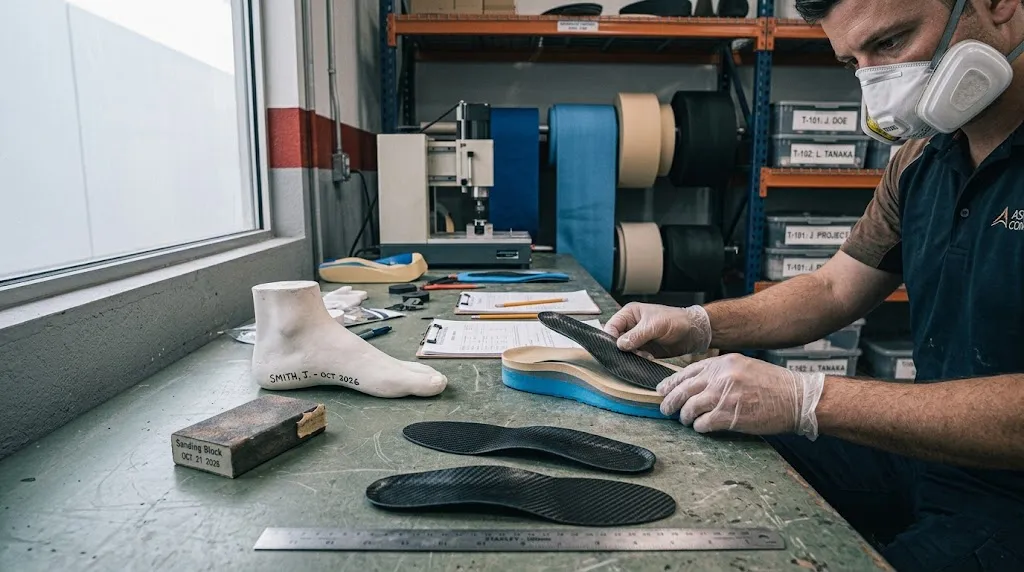
The tradeoff clinicians should note: carbon plates are molded to a positive model of the patient's foot and cannot be heat-adjusted at the bench the way polypropylene can. That shifts adaptation effort upstream to scanning and molding, and makes dimensional accuracy at fabrication time more critical.
Design Details That Decide Comfort and Durability
Most field failures of carbon fiber plates trace to details rather than bulk strength. Edge radius, ply termination and surface finish each matter:
- Edge radii: A minimum 2 to 3 mm radius on all perimeter edges prevents stress concentration and skin irritation. Sharp routed edges are the leading cause of stockinette wear-through in AFOs.
- Ply drop-offs: Stepped taper zones, never abrupt ply terminations, when stiffness must reduce toward the heel or toe. A taper spread over 30 to 50 mm preserves roughly 90 percent of the parent laminate's fatigue life.
- Surface sealing: A thin polyurethane or epoxy topcoat seals the laminate against perspiration ingress, which can plasticize the matrix interface over months of daily wear.
- Attachment strategy: Bond plates into EVA or cork carriers rather than mechanically fastening; point fasteners punch through CFRP under cyclic load. Contact-bond with polyurethane adhesive and sand the carbon surface to 120 grit before bonding.
For running-shoe applications the same principles apply at thinner gauges, with one addition: plate curvature (toe spring and rocker) is designed into the mold, not bent into the finished plate. Post-forming a cured CFRP plate introduces microcracks that halve fatigue life in heel-toe flex testing.
Fatigue, Inspection and Replacement Intervals for a Carbon Fiber Plate
Foot plates see roughly one million loading cycles per year for an active walking patient, and performance runners can accumulate that in a single marathon block. Carbon UD laminates tolerate this comfortably when designed within strain limits — the failure mode to watch is not catastrophic snap but progressive delamination at edges and bond lines. Inspection is simple: flex the plate gently along its length under good light and look for shear wrinkles in the surface, listen for crackling, and check bond-line edges for separation. Any audible crackling or visible delamination growth means replacement; a plate that has lost 10 percent of its stiffness through damage no longer delivers its clinical or performance intent even though it still holds shape.
Replacement intervals: clinical AFO plates typically last 12 to 24 months depending on patient mass and activity; performance footwear plates are usually retired with the midsole once outsole wear is visible, since foam degradation changes the plate's working environment before the carbon itself fatigues.
Frequently Asked Questions
Why use carbon fiber plate in shoe orthotics instead of polypropylene?
Carbon delivers the same stiffness at roughly half the thickness, which matters inside modern low-volume footwear, and it does not creep under sustained load the way polypropylene does. The tradeoff is that carbon cannot be heat-adjusted in the clinic, so it requires accurate digital or plaster measurement before fabrication, and it costs more per plate.
Can a carbon fiber rigid plate be trimmed or adjusted after fabrication?
Trimming down the perimeter is acceptable if edges are re-sealed and re-radiused; removing more than 2 to 3 mm from a load-bearing span changes stiffness noticeably and should be avoided. Bending adjustments are not safe — CFRP does not yield like thermoplastics, and forced bending creates sub-surface cracks. Shape changes require a new mold or, for small corrections, a compensating cover layer bonded locally.
How stiff should a carbon fiber plate for foot orthotics be?
Stiffness targets depend on the clinical goal. For gait-control AFOs, 20 to 35 N/mm midfoot bending stiffness suits most adult ambulatory patients; for accommodative insoles, 8 to 15 N/mm preserves some motion while offloading. For performance footwear the metric is forefoot bending stiffness, typically tested on a three-point bend fixture at a defined span — match plate stiffness to midsole foam stiffness rather than copying a competitor's thickness, since foam modulus varies more between brands than plate modulus does.
Do carbon plates in shoes conduct electricity or interfere with scanners?
Carbon fiber is electrically conductive, but a plate inside a shoe presents no practical interference in daily use — airport and medical scanners may show it as an artifact, which is worth mentioning to technicians but is not a safety issue. The conductive concern that matters clinically is galvanic coupling when carbon plates contact titanium or steel implants through perspiration-moistened soft tissue; a thin insulating fabric layer at the interface resolves it.
Conclusion
Designing a carbon fiber plate for foot applications reduces to matching layup and thickness to a measured stiffness target, finishing edges and terminations with care, and setting realistic inspection and replacement cycles. Carbon's specific stiffness and fatigue resistance make it the material of choice for clinical AFOs and performance footwear alike, provided the plate is molded rather than post-formed, bonded rather than fastened, and inspected for delamination rather than judged by appearance alone. For custom plate programs, supply the stiffness target, geometry envelope and patient or athlete profile, and the layup follows from first principles.
YongXian supplies cut-to-shape carbon fiber plates and custom molded laminate components for orthotic and footwear programs. Browse our carbon fiber plate range or contact our engineering team with your stiffness targets and geometry for material recommendations.
Part of topic
Related Articles
- Carbon Fiber Robot Arms: Lightweight Design Tradeoffs
- Carbon Fiber License Plate Custom Guide: Frames That Fit and Last
- Building Carbon Fiber Drone Frames: Layout and Fastening
- Carbon Fiber Tube for Drone Frames: Sizing and Wall Selection
- Carbon Fiber Plates for Running Shoes: How They Work
- Carbon Fiber Drone: When Composite Airframes Make Sense
Interested in Our Products?
Contact our team for competitive pricing and technical specifications.
Get a QuoteRelated Products

Round Carbon Fiber Tube — 3K Plain Weave T700
Standard round carbon fiber tube manufactured from Toray T700 grade fiber with 3K plain weave. Offers balanced strength and stiffness for general industrial applications including robotics, automation, sports equipment, and aerospace structures.

Square Carbon Fiber Tube — 3K Twill T700
Square cross-section carbon fiber tube manufactured with 3K twill weave for torsional strength. Preferred for structural frames, trusses, and support columns where rectangular geometry offers design flexibility.

Round Carbon Fiber Tube — 3K Twill
Lightweight and ultra-stiff round tubes ideal for drone frames, robotics, and structural applications.

Round Carbon Fiber Tube — UD Unidirectional T700
Unidirectional (UD) round tube with all fibers aligned axially for maximum longitudinal stiffness. Ideal for applications requiring high bending rigidity with minimal weight, such as shafts, struts, and structural reinforcements.

Carbon Fiber Plate — 3K Twill T700 3.0mm
Medium-thickness 3.0mm carbon fiber plate offering significantly higher load capacity while maintaining attractive 3K twill finish. Suitable for structural brackets, reinforcement plates, and load-bearing panels.